 Bitcoin
  Ethereum
  Tether
  XRP
XRP  BNB
BNB  USDC
USDC  Solana
  TRON
TRON  Lido Staked Ether
  Figure Heloc
  Dogecoin
  USDS
USDS  WhiteBIT Coin
  Cardano
  Bitcoin Cash
  Wrapped stETH
  Hyperliquid
  LEO Token
  Wrapped Bitcoin
  Chainlink
  Binance Bridged USDT (BNB Smart Chain)
  Monero
  Wrapped Beacon ETH
  Ethena USDe
  Canton
  Stellar
  Wrapped eETH
  USD1
USD1  Dai
Dai  sUSDS
sUSDS  Litecoin
  Rain
Rain  Avalanche
  Coinbase Wrapped BTC
  PayPal USD
  Hedera
  Zcash
Zcash  WETH
WETH  Sui
Sui  Shiba Inu
  Toncoin
  USDT0
USDT0  Cronos
  MemeCore
  Bittensor
  World Liberty Financial
  Circle USYC
  Tether Gold
  Polkadot
  Ethena Staked USDe
  Mantle
  Uniswap
  PAX Gold
  BlackRock USD Institutional Digital Liquidity Fund
  Pi Network
  OKB
OKB  Global Dollar
  Falcon USD
  NEAR Protocol
  Aave
Aave  Sky
Sky  syrupUSDC
  Aster
Aster  HTX DAO
  Ripple USD
  Pepe
Pepe  Bitget Token
  BFUSD
BFUSD  Ethereum Classic
  Ondo US Dollar Yield
  Internet Computer
  Ondo
Ondo  Gate
Gate  KuCoin
  Pump.fun
  Quant
Quant  POL (ex-MATIC)
  Jupiter Perpetuals Liquidity Provider Token
  Worldcoin
  Spiko EU T-Bills Money Market Fund
  Janus Henderson Anemoy Treasury Fund
  Superstate Short Duration U.S. Government Securities Fund (USTB)
  Kaspa
Kaspa  Jito Staked SOL
  Morpho
  NEXO
NEXO  Kelp DAO Restaked ETH
  Render
  Cosmos Hub
  Binance-Peg WETH
  Aptos
Aptos  Rocket Pool ETH
  Provenance Blockchain
  USDtb
USDtb  Binance Bridged USDC (BNB Smart Chain)
  Midnight
  Ethena
  Wrapped BNB
  USDD
USDD  Function FBTC
  Algorand
  Official Trump
  Siren
Siren  Filecoin
  OUSG
OUSG  syrupUSDT
  Flare
Flare  XDC Network
  Beldex
  Binance Staked SOL
  VeChain
  YLDS
YLDS  GHO
GHO  Arbitrum
  Stable
  Usual USD
  Polygon Bridged USDC (Polygon PoS)
  JUST
JUST  Solv Protocol BTC
  LayerZero
  Lombard Staked BTC
  Jupiter
  Bonk
Bonk  Artificial Superintelligence Alliance
  clBTC
clBTC  TrueUSD
  A7A5
A7A5  Fasttoken
  PancakeSwap
  Virtuals Protocol
  Stacks
  StakeWise Staked ETH
  Pudgy Penguins
  Dash
Dash  Kinetiq Staked HYPE
  tBTC
tBTC  River
River  EURC
EURC  WrappedM by M0
  Tezos
Tezos  Janus Henderson Anemoy AAA CLO Fund
  Ether.fi
  Kite
Kite  Sei
Sei  First Digital USD
  c8ntinuum
  Decred
  Mantle Staked Ether
  Sun Token
  Chiliz
  Polygon PoS Bridged DAI (Polygon POS)
  USX
USX  Resolv wstUSR
  PRIME
PRIME  COCA
COCA  DeXe
DeXe  Gnosis
  Kinesis Gold
  Liquid Staked ETH
  AINFT
AINFT  Arbitrum Bridged WBTC (Arbitrum One)
  Curve DAO
  BitTorrent
  ADI
ADI  Conflux
  Wrapped Flare
  Aerodrome Finance
  USDai
USDai  L2 Standard Bridged WETH (Base)
  Injective
  Steakhouse USDC Morpho Vault
  Kaia
Kaia  Celestia
  FLOKI
FLOKI  Bitcoin SV
  JasmyCoin
  Binance-Peg XRP
  Legacy Frax Dollar
  Ether.Fi Liquid ETH
  SPX6900
  Renzo Restaked ETH
  The Graph
  Maple Finance
  sBTC
sBTC  Ape and Pepe
  DoubleZero
  Official FO
  Jupiter Staked SOL
  crvUSD
  Savings USDD
  IOTA
IOTA  Venice Token
  Lido DAO
  Marinade Staked SOL
  Olympus
  Arbitrum Bridged WETH (Arbitrum One)
  Helium
  Optimism
  BTSE Token
  TheTrumpToken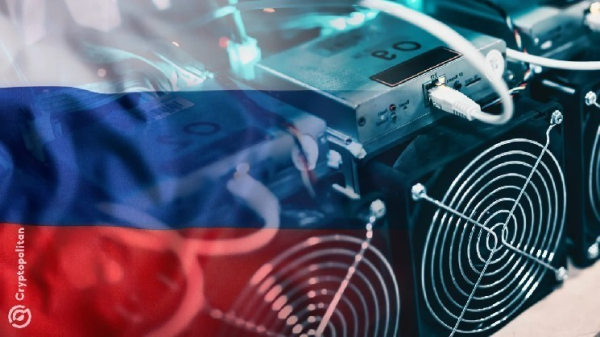


The number of mining farms in Russia has seen a significant increase over the past year, since Moscow legalized the crypto activity in 2024.
The upward trend is largely due to growing investments in the sector following its recognition as a legitimate business, industry sources say. Others claim illegal mining is contributing, too.
Russia counts its cryptocurrency farms using AI tech
Farms minting digital currencies like Bitcoin have increased by 44% this year despite a ban that’s now covering a dozen Russian regions, affected by energy shortages blamed on the mining boom.
Their total number has reached 196,900, according to a report produced by a new system designed to identify such facilities, even when they are not officially reported to the state.
The EnergyTool platform has been developed by the Russian telecom company MTS. It discovers crypto mining installations by monitoring electricity consumption.
It’s doing that by analyzing information collected from automated metering systems in real time, using AI to register anomalies in power usage, thus detecting unauthorized connections to the grid, tampering of measuring instruments and unusual loads.
The solution, which relies on artificial intelligence and machine learning algorithms, has been in operation for a few years now. In January, MTS announced it had obtained a patent for it.
According to the latest data from the tool, quoted by the business news editions RBC and Kommersant, crypto farms have been mushrooming across Russia in 2025. For comparison, they numbered 136,600 at the end of 2024, which was just a 7% increase year-on-year.
Irkutsk keeps Russia’s mining capital title amid restrictions
According to the MTS analysis, three Russian regions are leading the chart by newly discovered crypto farms – the Siberian oblasts of Irkutsk and Novosibirsk, and the Southern Republic of Bashkortostan (Bashkiria).
Irkutsk, often dubbed the mining capital of Russia, has been a magnet for cryptocurrency miners due to its relatively low electricity rates.
The high concentration of both legal and illegal coin minting operations there led to a permanent mining ban in the south of the region. More than 10 Russian regions have already prohibited the activity until 2031.
Meanwhile, the Republic of Khakassia has taken the lead from Irkutsk as the most profitable place for mining, followed by the Tyumen and Murmansk regions.
The smallest number of recently found mining facilities was registered in Volgograd, Ivanovo, and Sverdlovsk regions, the Chuvash Republic (Chuvashia), the Yamalo-Nenets Autonomous Okrug, the Altai Krai, as well as in the territories forming the Central Black Earth Region.
Fresh investment driving growth in Russia’s mining industry
The findings in the MTS study suggest that the legalization of cryptocurrency mining, which became Russia’s first regulated crypto industry, is largely responsible for the rapid expansion of the business, thanks to the inflow of investment money.
Sergey Bezdelov, head of Russia’s Industrial Mining Association, agrees that the spike is a direct consequence of the sector’s recognition as an investment vehicle. He elaborated:
“Since the state regulation of mining in August 2024, institutional investors have finally shifted toward the industry, which results in these figures.”
While Bezdelov partially attributed the increase to mining operations getting out of the shadow economy, he also noted it’s hard to count those that remain under the radar.
To mine legally in Russia, companies and individual entrepreneurs are required to only register with the Federal Tax Service (FNS) and pay taxes.
However, the percentage of actual registrations remains pretty low, hovering around 30%, revealed an estimate recently quoted by Russian officials.
Proposed solutions to the issue include a plan to criminalize illegal mining and a suggestion to offer amnesty for enterprises operating in the “gray” zone.
Russian authorities have been cracking down on criminal activities in the space, employing increasingly sophisticated means, tracking electricity consumption via smart meters and internet traffic with the help of telecom companies.
At the same time, the growing importance of the crypto mining industry for the sanctioned Russian economy has been acknowledged by both the Bank of Russia and the Kremlin, as reported by Cryptopolitan.
For now, it remains unclear whether the legal or the illegal segment of the market contributes more to its rising importance.
Anton Gontarev, commercial director of Intelion Data Systems, a major player in the industry, agreed with Bezdelov that the upward trend is due to the influx of serious capital into the now-regulated space.
On the other hand, a representative of the Russian energy company EN+ tied the increasing number of crypto farms mostly to the growth of illegal mining.
