 Bitcoin
  Ethereum
  Tether
  BNB
BNB  XRP
XRP  USDC
USDC  Solana
  TRON
TRON  Lido Staked Ether
  Figure Heloc
  Dogecoin
  WhiteBIT Coin
  USDS
USDS  Hyperliquid
  Cardano
  Wrapped stETH
  LEO Token
  Zcash
Zcash  Wrapped Bitcoin
  Bitcoin Cash
  Binance Bridged USDT (BNB Smart Chain)
  Monero
  Wrapped Beacon ETH
  Chainlink
  Toncoin
  Canton
  Wrapped eETH
  Stellar
  MemeCore
  USD1
USD1  sUSDS
sUSDS  Dai
Dai  Litecoin
  Coinbase Wrapped BTC
  Avalanche
  Ethena USDe
  Sui
Sui  WETH
WETH  Hedera
  Shiba Inu
  Rain
Rain  USDT0
USDT0  PayPal USD
  Cronos
  Circle USYC
  Bittensor
  Tether Gold
  Global Dollar
  BlackRock USD Institutional Digital Liquidity Fund
  Ethena Staked USDe
  World Liberty Financial
  PAX Gold
  Polkadot
  Mantle
  Uniswap
  NEAR Protocol
  Pi Network
  Sky
Sky  OKB
OKB  Falcon USD
  Little Pepe
  HTX DAO
  Ondo
Ondo  syrupUSDC
  Pepe
Pepe  Aster
Aster  Internet Computer
  Ripple USD
  Bitget Token
  USDD
USDD  Ethereum Classic
  Aave
Aave  Ondo US Dollar Yield
  Morpho
  BFUSD
BFUSD  Janus Henderson Anemoy Treasury Fund
  Algorand
  KuCoin
  Jupiter Perpetuals Liquidity Provider Token
  Ethena
  POL (ex-MATIC)
  United Stables
  Superstate Short Duration U.S. Government Securities Fund (USTB)
  Render
  Jito Staked SOL
  Quant
Quant  Spiko EU T-Bills Money Market Fund
  Kelp DAO Restaked ETH
  Kaspa
Kaspa  Blockchain Capital
  Binance-Peg WETH
  Cosmos Hub
  Rocket Pool ETH
  NEXO
NEXO  Worldcoin
  Binance Bridged USDC (BNB Smart Chain)
  Filecoin
  Gate
Gate  Wrapped BNB
  Aptos
Aptos  Function FBTC
  Arbitrum
  Siren
Siren  Stable
  JUST
JUST  Pump.fun
  syrupUSDT
  Flare
Flare  Jupiter
  VeChain
  Binance Staked SOL
  Pudgy Penguins
  Dash
Dash  USDtb
USDtb  Beldex
  OUSG
OUSG  Provenance Blockchain
  NEW X CEO IS BACK
  Polygon Bridged USDC (Polygon PoS)
  SkyAI
SkyAI  Solv Protocol BTC
  Bonk
Bonk  Lombard Staked BTC
  XDC Network
  GHO
GHO  Virtuals Protocol
  clBTC
clBTC  Venice Token
  DeXe
DeXe  Usual USD
  Official Trump
  YLDS
YLDS  MegaUSD
  StakeWise Staked ETH
  Midnight
  A7A5
A7A5  Kinetiq Staked HYPE
  Terra Luna Classic
  tBTC
tBTC  PancakeSwap
  WrappedM by M0
  Artificial Superintelligence Alliance
  TrueUSD
  edgeX
edgeX  Stacks
  Chiliz
  EURC
EURC  c8ntinuum
  Aerodrome Finance
  Mantle Staked Ether
  ADI
ADI  Sei
Sei  Polygon PoS Bridged DAI (Polygon POS)
  Tezos
Tezos  First Digital USD
  Resolv wstUSR
  COCA
COCA  Janus Henderson Anemoy AAA CLO Fund
  USDGO
USDGO  SPX6900
  Doge Strategy
  Liquid Staked ETH
  Sun Token
  Arbitrum Bridged WBTC (Arbitrum One)
  Injective
  USX
USX  Monad
Monad  LayerZero
  Wrapped Flare
  Humanity
  Kite
Kite  L2 Standard Bridged WETH (Base)
  Curve DAO
  Steakhouse USDC Morpho Vault
  币安人生 (BinanceLife)
  Kinesis Gold
  Ether.fi
  Celestia
  Gnosis
  Binance-Peg XRP
  Decred
  Ether.Fi Liquid ETH
  BUILDon
  Renzo Restaked ETH
  FLOKI
FLOKI  Conflux
  Noon
Noon  sBTC
sBTC  apxUSD
  PRIME
PRIME  Bitcoin SV
  Jupiter Staked SOL
  Zebec Network
  Savings USDD
  BitTorrent
  Lido DAO
  AINFT
AINFT  Marinade Staked SOL
  DoubleZero
  Arbitrum Bridged WETH (Arbitrum One)


Calvin James
-
CZ rejects Forbes’ $100B+ net worth estimate, calling it a “guess.”
-
The dispute highlights difficulties in valuing crypto wealth due to market volatility.
-
Zhao’s wealth is tied to Binance, making an accurate valuation complex amidst fluctuating crypto prices.
Arguably the most famous figure in the cryptocurrency world, Changpeng Zhao, or CZ, publicly refuted recent reports of his personal wealth, following a popular ranking that he is one of the wealthiest people in the world. The founder and the former chief executive of Binance have denied the estimates released by Forbes valuing his net worth to be over 100 billion dollars, terming the figures as being untrue and not in line with the prevailing state of the crypto market.
The controversy was created when Forbes compiled the 2026 billionaire lists and pegged Zhao to have a wealth of about $110billion, thus ranking him higher than a number of high-profile listings, including Microsoft co-founder Bill Gates. The ranking is said to have ranked Zhao at about 17 th in the world wealth list, which was a huge leap in estimated fortune since previous valuations.
Zhao was among the first to counter the report by comments on the social media X, where he stated that the resulting estimate methodology did not make logical sense. In his reaction, he opined that the figures were speculative estimates as opposed to what his real wealth would be. Zhao writes that it does not make sense to call his fortune worth above $100 billion at a time of falling cryptocurrency prices, and the figure is merely a guess.
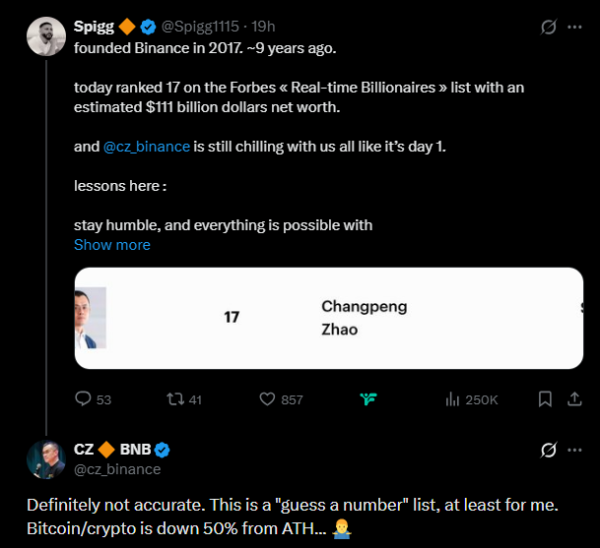
The conflict emphasizes that the problem of the correct valuation of the fortunes of entrepreneurs whose investments are closely linked with the private firms and unstable electronic resources is still topical. In comparison to the old industries where the stock market values and public filings give a more accurate picture of the actual state of things, crypto founders usually possess sizeable shares of wealth in tokens, personal equity interests, and exchange proceeds that change radically in value.
Market Volatility and Crypto Wealth Calculations
Among the main criticisms of the Forbes estimate by Zhao is the overall situation in the cryptocurrency market. At least based on his statements, the value of digital assets has fallen significantly since the time of highs, so the idea of a drastic increase in personal wealth is doubtful. Zhao indicated that the crypto market has fallen by about 50 percent in comparison with the highs, and that those circumstances would not tend to lift, but would diminish the worth of holdings linked with the industry.
This contradiction is the main argument of Zhao. In case most of his wealth is associated with cryptocurrency holdings or the value of Binance, a dramatic decrease in the market is therefore expected to be directly reflected in his net worth. Rather, the billionaire ranking indicated the opposite trend, and Zhao wonders how this was calculated to represent the number.
The billionaire ranking is said to have considered a dramatic rise in the valuation of Binance, the largest cryptocurrency exchange in the world in terms of trading volume. There is a feeling among analysts that the exchange would be worth close to 100 billion, and this would make Zhao add millions of dollars to his estimated wealth because he owns a big portion of the company.
Reports suggest that Zhao continues to have a significant stake in Binance, and he also owns large quantities of Binance Coin ($BNB), the native cryptocurrency token of the platform. According to certain estimates, he is estimated to own approximately 90 percent of the corporation and a big part of the current $BNB supply, which can significantly affect the calculation of wealth depending on the fluctuations in the price of the tokens.
Nevertheless, Zhao claims that the traditional logic of valuation applied to crypto businesses can give false results. He pointed out that there are more established technology companies that make much more money, but that still rank poorer on wealth lists than crypto-industrialists, which indicates inconsistencies in where analysts transform corporate outcomes into individual net assets.
The Difficulty of Measuring Crypto Fortunes
The conflict between Zhao and Forbes is a symptom of a larger issue with financial reporting, which is the difficulty of estimating the wealth of people whose assets are linked to volatile markets and obscure corporate governance.
In the example of Binance, its exchange is privately owned, and its detailed financial statements are not publicly disclosed, as is the case with listed companies. This has forced the valuation of wealth to be based on indirect measures like the volume, market share, and number of tokens owned by the companies, and the assumption on the value of those companies.
Binance is still the largest cryptocurrency exchange in the world, with a reported market share of about 38 percent in the digital asset trading across the globe. That is why Zhao was included among the most powerful players in the crypto ecosystem and appears in the billionaire lists and speculation regularly.
But the same forces that add to the power of Binance make it difficult to estimate the personal fortune of Zhao. The value of cryptocurrencies may change by a significant margin in the course of a few weeks or even days; this implies that the worth of huge token holders may change by billions of dollars within a short time.
Moreover, a large part of the wealth owned by Zhao is considered to be illiquid. It may be that as much as the estimated value of his holdings may be on paper worth over $100 billion, it would be hard to convert such assets into cash without making markets to be disrupted in the market. Wealth ranking systems do not usually distinguish between hypothetical net worth and available capital.
A Controversial Figure in Crypto
The fresh focus on the wealth of Zhao follows an unstable stage in his career and the cryptocurrency sector in general. Zhao established Binance in 2017, and within a short period of time, he managed to make it the biggest digital asset trading platform, which contributed to the growth of cryptocurrency markets worldwide.
There has however, been regulatory scrutiny of his tenure in the company as well. Zhao resigned as chief executive in November 2023 following a guilty plea to breaching the U.S. anti-money-laundering laws. As a settlement to authorities in the United States, Binance agreed to pay over 4.3 billion in fines, with Zhao himself paying over 50 million in fines.
Then, Zhao was sentenced to four months in prison on the case, which became world headlines because of the size of his fortune and his contribution to the crypto industry. Nevertheless, Binance has been able to remain in business even with the legal difficulties in place, as Zhao remains a large shareholder and a key influence in the business.
The list of billionaires that ranked Zhao as one of the richest people in the world, therefore, received special attention. It was seen by some as the sign of crypto resilience despite regulatory losses, and some wondered whether these valuations are precisely a reflection of the economic reality of the sector.
The reaction of Zhao to the Forbes rankings soon gained traction on social media, where crypto circles and analysts argued about the rationality of the wealth of billionaires’ estimates. The screenshots of the ranking spread over X and other platforms, and discussions were held regarding how analysts value crypto-related assets.
Proponents of Zhao claimed that conventional financial media can be prone to failure in comprehending the operations of decentralized finance and token economics. They stated that trying to use the traditional models of valuation to value blockchain firms can give distorted outputs.
Critics, though, pointed out that public figures are often criticized when it seems that they are too exaggerated or politically delicate. Billionaire lists are usually based on incomplete data, implying that the controversy over the net worth is usual in the case of people whose asset is hard to measure.
The Bigger Picture for Crypto Billionaires
The conflict between Zhao and Forbes highlights the bigger transformation of wealth in the digital era. The entrepreneurs within the cryptocurrency industry have become among the richest people in the world in less than ten years, with regard to the openness of their fortunes still being minimal when compared to the conventional industries.
Cryptocurrency exchanges, in contrast to publicly traded technology giants like Microsoft or Apple, are usually regulated and report financial data differently across the world, though with some exceptions. This complicates the valuation of accurate valuation by the analysts or identifying the accurate division of ownership interests.
Because of this, the estimation of wealth among persons such as Zhao can vary tremendously based on the assumptions applied in the determination. The addition or removal of tens of billions of dollars of estimated net worth in one or more changes in token price, exchange valuation, or market sentiment can erase or add tens of billions of dollars of estimated net worth in a single night.
To Zhao, personally, the argument about his wealth might turn out to be a lesser issue in the long run compared to the fact that he remains influential in the cryptocurrency world. However, the actual number is still unclear, but it is hardly doubted that the Binance founder can still be seen as one of the most influential persons in the field.
