 Bitcoin
  Ethereum
  Tether
  XRP
XRP  BNB
BNB  USDC
USDC  Solana
  TRON
TRON  Lido Staked Ether
  Figure Heloc
  Dogecoin
  WhiteBIT Coin
  USDS
USDS  Hyperliquid
  LEO Token
  Wrapped stETH
  Cardano
  Bitcoin Cash
  Wrapped Bitcoin
  Monero
  Binance Bridged USDT (BNB Smart Chain)
  Zcash
Zcash  Wrapped Beacon ETH
  Chainlink
  Canton
  Stellar
  Wrapped eETH
  USD1
USD1  Dai
Dai  sUSDS
sUSDS  Litecoin
  Avalanche
  Ethena USDe
  Coinbase Wrapped BTC
  Toncoin
  Hedera
  Sui
Sui  WETH
WETH  Shiba Inu
  Rain
Rain  MemeCore
  USDT0
USDT0  PayPal USD
  Cronos
  Circle USYC
  Bittensor
  Tether Gold
  Global Dollar
  BlackRock USD Institutional Digital Liquidity Fund
  Ethena Staked USDe
  PAX Gold
  Mantle
  Uniswap
  Polkadot
  World Liberty Financial
  Pi Network
  Sky
Sky  OKB
OKB  Falcon USD
  HTX DAO
  Little Pepe
  Aster
Aster  Pepe
Pepe  syrupUSDC
  NEAR Protocol
  Ondo
Ondo  Ripple USD
  USDD
USDD  Bitget Token
  Aave
Aave  Ethereum Classic
  Ondo US Dollar Yield
  BFUSD
BFUSD  Janus Henderson Anemoy Treasury Fund
  Internet Computer
  Morpho
  KuCoin
  POL (ex-MATIC)
  Jupiter Perpetuals Liquidity Provider Token
  United Stables
  Algorand
  Superstate Short Duration U.S. Government Securities Fund (USTB)
  Quant
Quant  Spiko EU T-Bills Money Market Fund
  Jito Staked SOL
  Blockchain Capital
  Cosmos Hub
  Kelp DAO Restaked ETH
  Render
  Kaspa
Kaspa  Binance-Peg WETH
  NEXO
NEXO  Rocket Pool ETH
  Ethena
  Gate
Gate  Binance Bridged USDC (BNB Smart Chain)
  Worldcoin
  Aptos
Aptos  Wrapped BNB
  SkyAI
SkyAI  Function FBTC
  Stable
  Filecoin
  Arbitrum
  JUST
JUST  Pump.fun
  syrupUSDT
  Flare
Flare  Pudgy Penguins
  VeChain
  Binance Staked SOL
  Beldex
  OUSG
OUSG  Dash
Dash  Jupiter
  GHO
GHO  USDtb
USDtb  NEW X CEO IS BACK
  Polygon Bridged USDC (Polygon PoS)
  XDC Network
  Solv Protocol BTC
  Usual USD
  Lombard Staked BTC
  Siren
Siren  Terra Luna Classic
  Provenance Blockchain
  clBTC
clBTC  Bonk
Bonk  Official Trump
  YLDS
YLDS  Midnight
  TrueUSD
  PancakeSwap
  StakeWise Staked ETH
  MegaUSD
  DeXe
DeXe  Kinetiq Staked HYPE
  A7A5
A7A5  tBTC
tBTC  Virtuals Protocol
  WrappedM by M0
  Artificial Superintelligence Alliance
  edgeX
edgeX  EURC
EURC  Venice Token
  ADI
ADI  Aerodrome Finance
  c8ntinuum
  Stacks
  Mantle Staked Ether
  Chiliz
  BUILDon
  Polygon PoS Bridged DAI (Polygon POS)
  Janus Henderson Anemoy AAA CLO Fund
  First Digital USD
  Resolv wstUSR
  COCA
COCA  Sei
Sei  Tezos
Tezos  币安人生 (BinanceLife)
  Doge Strategy
  Liquid Staked ETH
  USX
USX  Arbitrum Bridged WBTC (Arbitrum One)
  Injective
  Sun Token
  Curve DAO
  Humanity
  Wrapped Flare
  SPX6900
  Ether.fi
  L2 Standard Bridged WETH (Base)
  LayerZero
  Steakhouse USDC Morpho Vault
  Monad
Monad  Manadia
  Kinesis Gold
  Gnosis
  Decred
  Binance-Peg XRP
  Zebec Network
  Ether.Fi Liquid ETH
  PRIME
PRIME  Renzo Restaked ETH
  Celestia
  Bitcoin SV
  Noon
Noon  sBTC
sBTC  Pendle
  BitTorrent
  Unibase
  Jupiter Staked SOL
  Lido DAO
  Savings USDD
  Conflux
  AINFT
AINFT  FLOKI
FLOKI  Marinade Staked SOL
  USDGO
USDGO  Arbitrum Bridged WETH (Arbitrum One)


DeFi protocols achieved one major shift in 2025 – they tripled the amount of value returned to token holders. In the past few months, various forms of revenue sharing accelerated.
DeFi protocols had one of their strongest years, bringing peak fees for some of the protocols. The big shift in 2025 is that more DeFi platforms introduced forms of revenue sharing.
As token prices stagnated, revenue sharing turned into an incentive for users to continue adopting new protocols. The shift started with Hyperliquid, later putting pressure on other protocols to distribute fees.
Widely used hubs like Pump.fun and Uniswap also moved toward revenue sharing. The apps were also pressured for their perceived extraction, without returning value to the crypto space.
DeFi protocols distributed 15% of fees
A growing share of DeFi revenues flowed back to token holders. Protocols removed previous forms of inflationary rewards, instead moving to buybacks, token burns, and other forms of value distribution. Fees were a game-changer in DeFi, showing blockchains could generate real revenues. The distribution did not come from new token minting, as in previous profit-sharing tools.
Only around 5% of protocol fees were distributed to holders before 2025. In the past year, the amount tripled to 15%, according to the DeFi Llama report on the industry.
Token holders could receive forms of revenue sharing, treasury yield, or general support from buybacks and burns. Not all buybacks had the same effect, as some tokens remained stagnant.
The trend has also reached major protocols like Aave, holding 60% of DeFi deposits, as well as the Uniswap DEX. More protocols resemble traditional financial markets and aim to bring intrinsic value to their tokens.
DEX and perp trading boosted fee sharing
Fee sharing came from many different decentralized protocols, but trading venues were the biggest producers.
Decentralized markets and perpetual futures DEXs became more competitive in 2025, increasing fee capture. Some of the protocols managed to become sustainably profitable, despite the slide in their token price.
The ability to become profitable meant DeFi protocols had more space to explore incentive models and new products.
As some networks scaled and offered lower costs, the revenue model no longer depended on token valuations. With low transaction fees, apps could afford to ask for fees in exchange for their services and access to liquidity.
The sliding gas fees on Ethereum and its L2 chains and the low fees on Solana encouraged DeFi innovation and brought more users to the space.
As of December 2025, Hyperliquid produces the highest holder revenues. For the past month, the platform distributed over $74M to holders. Hyperliquid peaked with $9.8M in daily distributions on October 10.
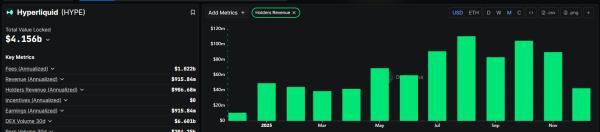
Hyperliquid was among the leaders for holder revenue, based on its peak performance as a trading hub in 2025. | Source: DeFi Llama
In 2025, the barrier to entering DeFi is no longer about the availability of infrastructure. Any project could build apps for yield, staking, liquid staking, or trading. However, some of the biggest protocols established themselves as leaders, securing the biggest share of users and the highest revenues.
As a result, communities could also pressure protocols into sharing some of their fees.
