 Bitcoin
  Ethereum
  Tether
  BNB
BNB  XRP
XRP  USDC
USDC  Solana
  TRON
TRON  Lido Staked Ether
  Figure Heloc
  Dogecoin
  USDS
USDS  WhiteBIT Coin
  LEO Token
  Cardano
  Wrapped stETH
  Bitcoin Cash
  Hyperliquid
  Wrapped Bitcoin
  Chainlink
  Binance Bridged USDT (BNB Smart Chain)
  Monero
  Wrapped Beacon ETH
  Ethena USDe
  Canton
  Stellar
  Wrapped eETH
  MemeCore
  Dai
Dai  sUSDS
sUSDS  Zcash
Zcash  USD1
USD1  Litecoin
  Coinbase Wrapped BTC
  PayPal USD
  Hedera
  Avalanche
  WETH
WETH  Sui
Sui  Shiba Inu
  Rain
Rain  USDT0
USDT0  Toncoin
  Bittensor
  World Liberty Financial
  Cronos
  Circle USYC
  Tether Gold
  PAX Gold
  Ethena Staked USDe
  BlackRock USD Institutional Digital Liquidity Fund
  Mantle
  Polkadot
  Global Dollar
  Uniswap
  Falcon USD
  OKB
OKB  Sky
Sky  Pi Network
  Aster
Aster  Little Pepe
  NEAR Protocol
  syrupUSDC
  HTX DAO
  USDD
USDD  Pepe
Pepe  Ripple USD
  Ondo US Dollar Yield
  Aave
Aave  BFUSD
BFUSD  Bitget Token
  Ethereum Classic
  Internet Computer
  Janus Henderson Anemoy Treasury Fund
  Ondo
Ondo  Gate
Gate  KuCoin
  Quant
Quant  Jupiter Perpetuals Liquidity Provider Token
  Algorand
  Superstate Short Duration U.S. Government Securities Fund (USTB)
  Pump.fun
  Render
  POL (ex-MATIC)
  Jito Staked SOL
  Spiko EU T-Bills Money Market Fund
  Morpho
  Kelp DAO Restaked ETH
  USDtb
USDtb  Kaspa
Kaspa  Binance-Peg WETH
  Cosmos Hub
  Rocket Pool ETH
  NEXO
NEXO  Worldcoin
  Binance Bridged USDC (BNB Smart Chain)
  Blockchain Capital
  Ethena
  Wrapped BNB
  Midnight
  Function FBTC
  OUSG
OUSG  Aptos
Aptos  Filecoin
  Official Trump
  Flare
Flare  syrupUSDT
  YLDS
YLDS  XDC Network
  Beldex
  Binance Staked SOL
  Provenance Blockchain
  VeChain
  GHO
GHO  Arbitrum
  JUST
JUST  Jupiter
  NEW X CEO IS BACK
  Polygon Bridged USDC (Polygon PoS)
  Usual USD
  Solv Protocol BTC
  Stable
  Lombard Staked BTC
  Artificial Superintelligence Alliance
  TrueUSD
  Bonk
Bonk  clBTC
clBTC  A7A5
A7A5  PancakeSwap
  LayerZero
  Siren
Siren  DeXe
DeXe  EURC
EURC  StakeWise Staked ETH
  Virtuals Protocol
  Janus Henderson Anemoy AAA CLO Fund
  Kinetiq Staked HYPE
  tBTC
tBTC  First Digital USD
  Stacks
  WrappedM by M0
  Pudgy Penguins
  Chiliz
  Dash
Dash  Tezos
Tezos  edgeX
edgeX  c8ntinuum
  PRIME
PRIME  ADI
ADI  Mantle Staked Ether
  USX
USX  Kinesis Gold
  Polygon PoS Bridged DAI (Polygon POS)
  Sei
Sei  Resolv wstUSR
  Ether.fi
  COCA
COCA  Decred
  Sun Token
  Doge Strategy
  Liquid Staked ETH
  AINFT
AINFT  Arbitrum Bridged WBTC (Arbitrum One)
  Bitcoin SV
  Gnosis
  BitTorrent
  Curve DAO
  Wrapped Flare
  Venice Token
  DoubleZero
  L2 Standard Bridged WETH (Base)
  Plasma
  Steakhouse USDC Morpho Vault
  Monad
Monad  Aerodrome Finance
  Injective
  Legacy Frax Dollar
  Kaia
Kaia  Binance-Peg XRP
  Official FO
  Ether.Fi Liquid ETH
  crvUSD
  Renzo Restaked ETH
  Kinesis Silver
  Lighter
  Noon
Noon  sBTC
sBTC  Kite
Kite  Lido DAO
  FLOKI
FLOKI  Jupiter Staked SOL
  SPX6900
  Savings USDD
  Conflux
  Celestia
  The Graph
  Marinade Staked SOL
  JasmyCoin
  Arbitrum Bridged WETH (Arbitrum One)
  Ape and Pepe


China’s recent directive for its state-owned banks to decrease reliance on the US dollar has amplified a growing trend among countries seeking alternatives to the dominant reserve assets. In some instances, Bitcoin has emerged as a viable competitor.
BeInCrypto spoke with experts from VanEck, CoinGecko, Gate.io, HashKey Research, and Humanity Protocol to understand Bitcoin’s rise as an alternative to the US dollar and its potential for greater influence in global geopolitics.
The Push for De-Dollarization
Since the 2008 global financial crisis, China has gradually reduced its reliance on the US dollar. The People’s Bank of China (PBOC) has now instructed state-owned banks to reduce dollar purchases amid the heightened trade war with US President Donald Trump.
China is among many nations seeking to lessen its dependence on the dollar. Russia, like its southern neighbor, has received an increasing number of Western sanctions– especially following its invasion of Ukraine.
The United States, the European Union, the United Kingdom, and other allies imposed unprecedented international sanctions on Russia, targeting its central bank and major financial institutions and restricting access to the Society for Worldwide Interbank Financial Telecommunication (SWIFT) for some financial institutions.
In response, Russia halted trading of US dollars and euros on the Moscow Stock Exchange (MOEX). Recently, BeInCrypto also reported that Russia has been quietly using Bitcoin for international trade to bypass sanctions.
Furthermore, Rosneft, a major Russian commodities producer, has issued RMB-denominated bonds, indicating a shift towards RBM, the Chinese currency, and a move away from Western currencies due to sanctions.
This global shift away from predominant reserve currencies is not limited to countries affected by Western sanctions. Aiming to increase the Rupee’s international use, India has secured agreements for oil purchases in Indian Rupee (INR) and trade with Malaysia in INR.
The country has also pursued creating a local currency settlement system with nine other central banks.
As more nations consider alternatives to the US dollar’s dominance, Bitcoin has emerged as a functional monetary tool that can serve as an alternative reserve asset.
Why Nations Are Turning to Bitcoin for Trade Independence
Interest in using cryptocurrency for purposes beyond international trade has also grown. In a notable development, China and Russia have reportedly settled some energy transactions using Bitcoin and other digital assets.
“Sovereign adoption of Bitcoin is accelerating this year as demand grows for neutral payments rails that can circumvent USD sanctions,” Matthew Sigel, Head of Digital Assets Research at VanEck, told BeInCrypto.
Two weeks ago, France’s Minister of Digital Affairs proposed using the surplus production of EDF, the country’s state-owned energy giant, to mine Bitcoin.
Last week, Pakistan announced similar plans to allocate part of its surplus electricity to Bitcoin mining and AI data centers.
Meanwhile, on April 10, New Hampshire’s House passed HB302, a Bitcoin reserve bill, by a 192-179 vote, sending it to the Senate. This development makes New Hampshire the fourth state, after Arizona, Texas, and Oklahoma, to have such a bill pass a legislative chamber.
If HB302 is approved by the Senate and signed into law, the state treasurer could invest up to 10% of the general fund and other authorized funds in precious metals and specific digital assets like Bitcoin.
According to industry experts, this is only the beginning.
VanEck Predicts Bitcoin to Become a Future Reserve Asset
Sigel predicts Bitcoin will become a key medium of exchange by 2025 and, ultimately, one of the world’s reserve currencies.
His forecasts suggest Bitcoin could settle 10% of global international trade and 5% of global domestic trade. This scenario would lead to central banks holding 2.5% of their assets in BTC.
According to him, China’s recent de-dollarization will prompt other nations to follow suit and lessen their reliance on the US dollar.
“China’s de-dollarization efforts are already having second- and third-order effects that create opportunities for alternative assets like Bitcoin. When the world’s second-largest economy actively reduces its exposure to US Treasuries and promotes cross-border trade in yuan or through mechanisms like the mBridge project, it signals to other nations—especially those with strained ties to the West—that the dollar is no longer the only game in town,” Sigel said.
For Zhong Yang Chan, Head of Research at CoinGecko, these efforts could prove catastrophic for the United States’ dominance.
“Broader de-dollarization efforts by China, or other major economies, will threaten the status of the dollar’s global reserve currency status. This could have [a] profound impact on the US and its economy, as this would lead to nations reducing their holdings of US treasuries, which the US relies on to finance its national debt,” he told BeInCrypto.
However, the strength of the US dollar and other dominant currencies has already shown signs of weakening.
A General Wave of Currency Decline
Sigel’s research shows that the four strongest global currencies—the US dollar, Japanese yen, British pound, and European euro—have lost value over time, particularly in cross-border payments.
The decline of these currencies creates a void where Bitcoin can gain traction as a key alternative for international trade settlements.
“This shift isn’t purely about promoting the yuan. It’s also about minimizing vulnerability to US sanctions and the politicization of payment rails like SWIFT. That opens the door for neutral, non-sovereign assets—especially those that are digitally native, decentralized, and liquid,” Sigel added.
This lack of national allegiance also sets Bitcoin apart from traditional currencies.
Bitcoin’s Appeal: A Non-Sovereign Alternative
Unlike fiat money or central bank digital currencies (CBDCs), Bitcoin doesn’t respond to any one nation, which makes it appealing to some countries.
For Terence Kwok, CEO and Founder of Humanity Protocol, recent geopolitical tensions have heightened this belief.
“Trust in traditional financial infrastructure is eroded during geopolitical standoffs. Bitcoin, with its transparent ledger and decentralized governance, offers a compelling alternative for value storage and peer-to-peer settlement, especially where neutral, non-sovereign options are preferable. In that sense, geopolitical tension can inadvertently catalyze innovation and adoption in decentralized finance,” Kwok told BeInCrypto.
Because Bitcoin’s supply is limited, it provides a more secure option for nations whose local currency loses value through inflation.
“Bitcoin, due to its scarcity and decentralized nature, is completely different from the centralized fiat currency system and is not affected by changes in monetary policy. Therefore, it can be used as a hedging tool to cope with the depreciation of fiat currencies or geopolitical risks. Especially in the context of rising inflation or challenges to the dominance of the US dollar, allocating some Bitcoin can help diversify investment risks and provide investors with more robust asset protection,” Kevin Guo, Director of HashKey Research, added to the conversation.
For these same reasons, experts don’t expect Bitcoin to replace fiat currencies fully but rather provide a vital alternative for certain cases.
A Replacement or an Alternative?
While Bitcoin offers several advantages over traditional currencies, Gate.io’s Kevin Lee doesn’t foresee its eventual adoption causing a complete overhaul of the currency reserve system.
“Bitcoin is increasingly being recognized for its unique technological characteristics, such as fixed supply, decentralized governance, and borderless accessibility. However, I don’t believe it is meant to replace [the] traditional fiat system, but rather an alternative to it for various business use cases, particularly for diversification and long-term value preservation strategies,” Lee told BeInCrypto.
Guo agreed with this last point, adding that Bitcoin will be more appealing case-by-case.
“Countries may selectively adopt Bitcoin based on their own economic needs, but its application areas are mainly concentrated in niche markets such as cross-border remittances, circumventing sanctions, and hedging inflation,” he said.
Bitcoin must first address several of its shortcomings before it can become truly competitive in the long run.
What Challenges Still Face Bitcoin’s Wider Adoption?
Due to its relatively new status and lack of full development, Bitcoin suffers from shortcomings that prevent mass adoption.
“As with any emerging asset class, Bitcoin faces inherent challenges, including market volatility, evolving regulatory frameworks, infrastructure maturity, and cyclical hypes. These factors may impact its short-term adoption pace,” Lee explained.
To that point, Kwok added:
“Bitcoin’s price swings make it less viable for day-to-day transactions or as a primary reserve asset today. Furthermore, if major powers enforce strict capital controls or implement hostile crypto policies, it could slow down adoption despite broader macro trends in its favor.”
Meanwhile, there’s the competitive advantage of stablecoins, which currently dominate cross-border payments.
“Crypto assets represented by US dollar stablecoins (such as USDT and USDC) are rapidly occupying the main market of cross-border payments and blockchain transactions. Stablecoins have low volatility due to their peg (mostly to the US dollar), making them the preferred tool for international transactions and fund transfers, while Bitcoin is more often used as a store of value or speculative asset,” Guo, Director of HashKey Research told BeInCrypto.
The Bitcoin network has also experienced problems that have exacerbated global demand.
Bitcoin Network Under Strain
Since the beginning of the year, Bitcoin has experienced a significant slowdown in network activity, despite the asset’s bullish performance.
“The usage rate of the Bitcoin network is declining, and its on-chain transaction fees have dropped to the lowest point since 2012, indicating that network activity is gradually decreasing,” Guo said.
Recent data confirms this. The number of Bitcoin transactions has fallen significantly since the last quarter of 2024. Bitcoin registered over 610,684 transactions in November, but that number dropped to 376,369 in April, according to Glassnode data.
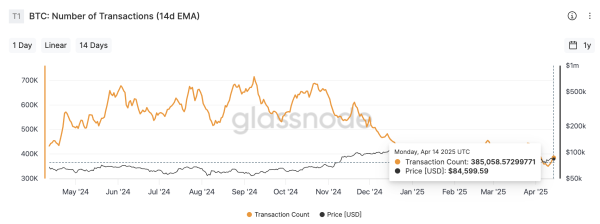
BTC number of transactions. Source: Glassnode.
The number of Bitcoin active addresses paints a similar picture. In December, the network had nearly 891,623 addresses. Today, that number stands at 609,614.
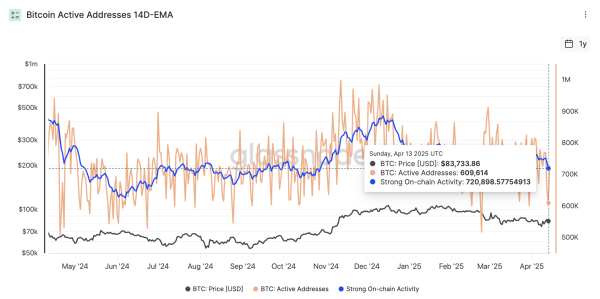
Bitcoin number of active addresses. Source: Glassnode.
This decline suggests reduced demand for its blockchain in terms of transactions, usage, and adoption, meaning fewer people are actively using it for transfers, business, or Bitcoin-based applications.
Meanwhile, the Bitcoin network must also ensure its infrastructure is efficient enough to meet global demand.
Can Bitcoin Scale for Global Use?
In 2018, Lightning Labs launched the Lightning Network to reduce the cost and time required for cryptocurrency transactions. Currently, the Bitcoin network can only handle around seven transactions per second, while Visa, for example, handles around 65,000.
“If expansion solutions (such as the Lightning Network) fail to become popular, Bitcoin’s ability to process only about 7 transactions per second will be difficult to support global demand. At the same time, as Bitcoin block rewards are gradually halved, the decline in miners’ income may threaten the long-term security of the network,” Guo, Director of HashKey Research explained.
While the confluence of geopolitical shifts and Bitcoin’s inherent characteristics undeniably create a space for its increased adoption as an alternative to the US dollar and even a potential reserve asset, significant hurdles remain.
Achieving mainstream Bitcoin adoption hinges on overcoming scalability, volatility, regulatory hurdles, stablecoin competition, and ensuring network security.
The unfolding panorama suggests Bitcoin will carve out an important role in the global financial system, though a complete overhaul of established norms seems unlikely in the immediate future.
