 Bitcoin
  Ethereum
  Tether
  XRP
XRP  BNB
BNB  USDC
USDC  Solana
  TRON
TRON  Lido Staked Ether
  Figure Heloc
  Dogecoin
  WhiteBIT Coin
  USDS
USDS  Hyperliquid
  LEO Token
  Wrapped stETH
  Cardano
  Bitcoin Cash
  Wrapped Bitcoin
  Monero
  Binance Bridged USDT (BNB Smart Chain)
  Chainlink
  Wrapped Beacon ETH
  MemeCore
  Stellar
  Canton
  Wrapped eETH
  Zcash
Zcash  Dai
Dai  sUSDS
sUSDS  Litecoin
  USD1
USD1  Avalanche
  Coinbase Wrapped BTC
  Ethena USDe
  Hedera
  Sui
Sui  WETH
WETH  Shiba Inu
  Rain
Rain  PayPal USD
  USDT0
USDT0  Toncoin
  Cronos
  Circle USYC
  Tether Gold
  BlackRock USD Institutional Digital Liquidity Fund
  World Liberty Financial
  Bittensor
  Ethena Staked USDe
  Global Dollar
  PAX Gold
  Mantle
  Polkadot
  Uniswap
  Sky
Sky  NEAR Protocol
  Falcon USD
  OKB
OKB  Pi Network
  Little Pepe
  HTX DAO
  Aster
Aster  syrupUSDC
  Pepe
Pepe  Janus Henderson Anemoy Treasury Fund
  Ripple USD
  Aave
Aave  USDD
USDD  Internet Computer
  Bitget Token
  Ethereum Classic
  Ondo US Dollar Yield
  BFUSD
BFUSD  Ondo
Ondo  KuCoin
  Gate
Gate  Pump.fun
  Jupiter Perpetuals Liquidity Provider Token
  Morpho
  Quant
Quant  United Stables
  Spiko EU T-Bills Money Market Fund
  POL (ex-MATIC)
  Jito Staked SOL
  Superstate Short Duration U.S. Government Securities Fund (USTB)
  Cosmos Hub
  Kelp DAO Restaked ETH
  Ethena
  Algorand
  Binance-Peg WETH
  Render
  Rocket Pool ETH
  Kaspa
Kaspa  NEXO
NEXO  Binance Bridged USDC (BNB Smart Chain)
  Stable
  Worldcoin
  Wrapped BNB
  Arbitrum
  Function FBTC
  Aptos
Aptos  Blockchain Capital
  Filecoin
  JUST
JUST  Flare
Flare  syrupUSDT
  Official Trump
  VeChain
  Beldex
  Binance Staked SOL
  Jupiter
  Midnight
  Provenance Blockchain
  OUSG
OUSG  XDC Network
  DeXe
DeXe  NEW X CEO IS BACK
  Polygon Bridged USDC (Polygon PoS)
  GHO
GHO  Solv Protocol BTC
  USDtb
USDtb  Lombard Staked BTC
  Bonk
Bonk  Usual USD
  YLDS
YLDS  clBTC
clBTC  Pudgy Penguins
  Chiliz
  PancakeSwap
  TrueUSD
  A7A5
A7A5  edgeX
edgeX  StakeWise Staked ETH
  Artificial Superintelligence Alliance
  Siren
Siren  Kinetiq Staked HYPE
  Dash
Dash  tBTC
tBTC  Virtuals Protocol
  WrappedM by M0
  EURC
EURC  ADI
ADI  Sei
Sei  Stacks
  First Digital USD
  Tezos
Tezos  c8ntinuum
  Janus Henderson Anemoy AAA CLO Fund
  Mantle Staked Ether
  LayerZero
  Aerodrome Finance
  Polygon PoS Bridged DAI (Polygon POS)
  Venice Token
  Resolv wstUSR
  USX
USX  COCA
COCA  Ether.fi
  Monad
Monad  币安人生 (BinanceLife)
  Doge Strategy
  Liquid Staked ETH
  Sun Token
  Arbitrum Bridged WBTC (Arbitrum One)
  SPX6900
  Kinesis Gold
  Decred
  Injective
  Wrapped Flare
  PRIME
PRIME  Curve DAO
  L2 Standard Bridged WETH (Base)
  Steakhouse USDC Morpho Vault
  Celestia
  Lido DAO
  Zebec Network
  FLOKI
FLOKI  BitTorrent
  Binance-Peg XRP
  AINFT
AINFT  Ether.Fi Liquid ETH
  Bitcoin SV
  Renzo Restaked ETH
  crvUSD
  Gnosis
  Noon
Noon  sBTC
sBTC  Conflux
  Pyth Network
  Terra Luna Classic
  Jupiter Staked SOL
  DoubleZero
  Savings USDD
  Kinesis Silver
  Kaia
Kaia  USDai
USDai  Marinade Staked SOL
  JasmyCoin
  Arbitrum Bridged WETH (Arbitrum One)
  Legacy Frax Dollar


The Ralph Wiggum Price (RALPH) and Gas Town (GAS) meme coins have plunged by double digits over the past 24 hours, wiping out a significant portion of their market value.
The decline has raised concerns about the durability of the emerging creator economy meta. Key questions remain about whether this new fundraising method can offer sustainable long-term value, or if it is repeating the short-lived spikes seen in previous crypto trends.
RALPH Token Nosedives After Developer’s Major Token Sale
Created on the BAGS app on Solana, the RALPH token commemorates the Ralph Wiggum Technique developed by Geoffrey Huntley. While he did not create or launch the token, Huntley later endorsed RALPH.
He also said that he would redirect his earnings and fees to purchase the meme coin. Moreover, Huntley was assigned 99% of royalties on a vesting schedule.
The token saw a notable rally, with its market cap surging to an all-time high of $58.74 million on January 21. However, RALPH saw its price collapse following on-chain revelations that the developer sold a significant portion of tokens.
Lookonchain identified that Huntley’s wallet (5f2Qj9) sold 7.68 million RALPH for 1,888 SOL worth approximately $245,000 across three transactions. The post added that another Huntley-linked wallet, 2mvtNn, holds 19.61 million RALPH.
This caused a massive downturn. The token lost 95.76% of its value over the past 24 hours. Market data showed that the token’s market cap has plunged to just $1.5 million, with its price at $0.0016.
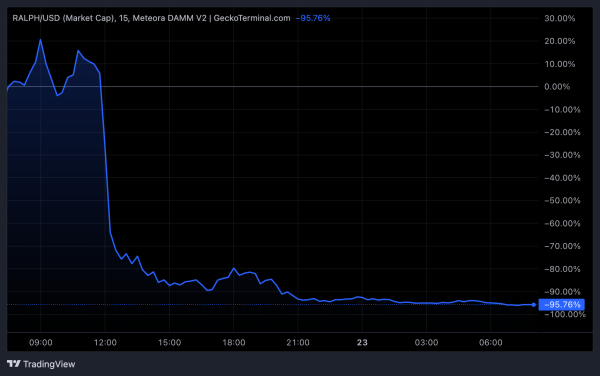
RALPH Token Price Decline. Source: GeckoTerminal
Meanwhile, Huntley acknowledged the sale, describing it as “de-risking.”
“I still hold ralph btw,” he stated. “It’s been a fun two weeks where folks have made millions trading this coin backwards and forwards. fees have been lovely but i too also needed to derisk my investments. there’s still a long road ahead. this was the easiest way to think long term without entering into super weird/sketchy grant contracts which would have been restraining and risky.”
GAS Token Mirrors Decline Amid Widespread Questions
The GAS token, linked to Gas Town, an open-source multi-agent AI orchestration platform created by Steve Yegge, also saw a sharp pullback. Just last week, BeInCrypto reported on the token’s 500% rally.
Nonetheless, GAS has reversed course. The reversal appears to have coincided with Yegge’s comments, which may have influenced market sentiment and prompted a shift in trader behavior.
“Hi $GAS and CT community. I love this community, but I’m the creator and sole maintainer of Gas Town, which is going viral. It’s a tremendous burden and is taking most of my day (and money). That’s where my time has to go. I can’t spend much time with CT. I will still drop the occasional blog post, and join streams or podcasts. But I am dedicated to Gas Town and have to focus there. I hope you understand! That’s the life of the creator economy,” he posted.
Still, it’s worth noting that the geopolitical tensions, which weighed on risk assets more generally, may have amplified the sell-off. GeckoTerminal recorded a 47.8% drop over 24 hours. GAS’s market cap now stands at around $508,000 from a $57.69 million peak on January 16, 2026.
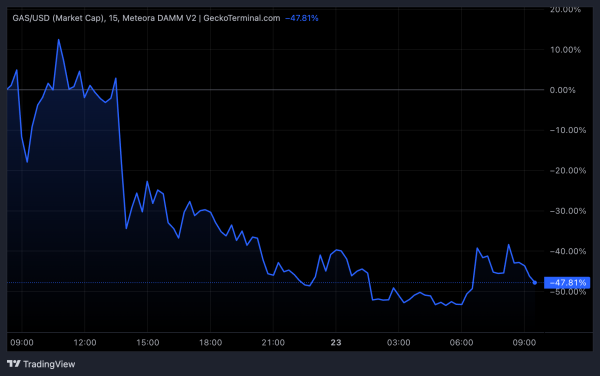
GAS Token Price Performance”> GAS Token Price Performance. Source: GeckoTerminal
What Went Wrong With RALPH and GAS Creator Coins?
RALPH and GAS’s rapid declines have fueled doubts about the creator economy meta, which aims to finance developers through crypto. A crypto analyst stated that core structural problems lead to recurring failures.
“The RALPH and GAS drama are a good lesson in why no coin should have a single point of failure, let alone a single point of failure from outside CT. ICM doesn’t work if the only incentive is fee extraction. If devs just collect fees, there’s no reason for them to care about long-term price, narrative, or community health etc,” boot wrote.
The analyst likened it to NFT launches, where most revenue comes in early, prompting short-term behavior. The post added that when tokens reach $50 million in market cap, developer-owners with 2% to 3% stakes may be tempted to sell.
Another market watcher suggested that GAS and RALPH did not fail because of the developers but because of supply manipulation and coordinated profit extraction by the token launchers. The post frames the incident as market manipulation rather than a developer-led rug pull.
I see a lot of blame going towards the web 2 builders @GeoffreyHuntley and @Steve_Yegge who collected fee money from bagsapp tokens. By bagsapp design they did nothing wrong as bagsapp is created to donate fees to people without them taking control of a project. Neither Geoff or… pic.twitter.com/N7FFPML2bs
— scooter (@imperooterxbt) January 22, 2026
RALPH and GAS exemplify the wider shift toward community-driven fundraising for developers. While bypassing venture capital via decentralized tokens is promising, the recent crashes show that clear alignment between creators and holders remains vital.
In the coming weeks, the market will test whether the creator economy can evolve or if it will join the ranks of former unsuccessful crypto movements.
The post RALPH and GAS Suffer Sharp Losses as Creator Economy Meta Faces Stress Test appeared first on BeInCrypto.
