 Bitcoin
  Ethereum
  Tether
  XRP
XRP  BNB
BNB  USDC
USDC  Solana
  TRON
TRON  Lido Staked Ether
  Figure Heloc
  Dogecoin
  WhiteBIT Coin
  USDS
USDS  Hyperliquid
  LEO Token
  Wrapped stETH
  Cardano
  Bitcoin Cash
  Wrapped Bitcoin
  Monero
  Binance Bridged USDT (BNB Smart Chain)
  Chainlink
  Wrapped Beacon ETH
  Zcash
Zcash  Canton
  Stellar
  Wrapped eETH
  MemeCore
  Dai
Dai  sUSDS
sUSDS  USD1
USD1  Litecoin
  Avalanche
  Coinbase Wrapped BTC
  Hedera
  Ethena USDe
  Sui
Sui  WETH
WETH  Shiba Inu
  Rain
Rain  PayPal USD
  USDT0
USDT0  Toncoin
  Cronos
  Circle USYC
  Tether Gold
  Global Dollar
  Bittensor
  World Liberty Financial
  Ethena Staked USDe
  BlackRock USD Institutional Digital Liquidity Fund
  PAX Gold
  Mantle
  Polkadot
  Uniswap
  Sky
Sky  Pi Network
  Falcon USD
  NEAR Protocol
  OKB
OKB  Little Pepe
  HTX DAO
  Pepe
Pepe  syrupUSDC
  Ripple USD
  Aster
Aster  Aave
Aave  USDD
USDD  Janus Henderson Anemoy Treasury Fund
  Bitget Token
  Internet Computer
  Ondo US Dollar Yield
  BFUSD
BFUSD  Ethereum Classic
  Ondo
Ondo  Morpho
  KuCoin
  Gate
Gate  Jupiter Perpetuals Liquidity Provider Token
  Superstate Short Duration U.S. Government Securities Fund (USTB)
  Pump.fun
  Spiko EU T-Bills Money Market Fund
  Algorand
  United Stables
  Jito Staked SOL
  Quant
Quant  Cosmos Hub
  Kelp DAO Restaked ETH
  POL (ex-MATIC)
  Render
  Binance-Peg WETH
  Ethena
  Rocket Pool ETH
  Kaspa
Kaspa  NEXO
NEXO  Binance Bridged USDC (BNB Smart Chain)
  Worldcoin
  Stable
  Wrapped BNB
  Arbitrum
  Function FBTC
  Aptos
Aptos  Blockchain Capital
  Filecoin
  JUST
JUST  Jupiter
  syrupUSDT
  DeXe
DeXe  Flare
Flare  VeChain
  Binance Staked SOL
  Beldex
  Provenance Blockchain
  XDC Network
  Pudgy Penguins
  OUSG
OUSG  Official Trump
  NEW X CEO IS BACK
  Polygon Bridged USDC (Polygon PoS)
  USDtb
USDtb  Solv Protocol BTC
  GHO
GHO  Lombard Staked BTC
  Midnight
  Usual USD
  Bonk
Bonk  clBTC
clBTC  YLDS
YLDS  Chiliz
  TrueUSD
  PancakeSwap
  A7A5
A7A5  Artificial Superintelligence Alliance
  StakeWise Staked ETH
  Virtuals Protocol
  edgeX
edgeX  Kinetiq Staked HYPE
  Siren
Siren  tBTC
tBTC  Dash
Dash  WrappedM by M0
  EURC
EURC  Aerodrome Finance
  ADI
ADI  Venice Token
  Stacks
  First Digital USD
  c8ntinuum
  Manadia
  Mantle Staked Ether
  Sei
Sei  Janus Henderson Anemoy AAA CLO Fund
  Polygon PoS Bridged DAI (Polygon POS)
  Tezos
Tezos  Resolv wstUSR
  LayerZero
  COCA
COCA  Zebec Network
  USX
USX  Monad
Monad  Doge Strategy
  Liquid Staked ETH
  Kinesis Gold
  Arbitrum Bridged WBTC (Arbitrum One)
  Ether.fi
  Injective
  SPX6900
  Sun Token
  Wrapped Flare
  币安人生 (BinanceLife)
  Curve DAO
  L2 Standard Bridged WETH (Base)
  Decred
  Steakhouse USDC Morpho Vault
  Terra Luna Classic
  PRIME
PRIME  Gnosis
  Lido DAO
  AINFT
AINFT  Binance-Peg XRP
  BitTorrent
  Ether.Fi Liquid ETH
  Celestia
  Renzo Restaked ETH
  Bitcoin SV
  Noon
Noon  sBTC
sBTC  Olympus
  FLOKI
FLOKI  Conflux
  Jupiter Staked SOL
  DoubleZero
  Savings USDD
  crvUSD
  JasmyCoin
  Maple Finance
  Marinade Staked SOL
  Ape and Pepe
  Arbitrum Bridged WETH (Arbitrum One)
  Kinesis Silver


Table of Contents
What is Igra Network? Architectural OverviewConsensus, Finality, and Security ModelPerformance and ScalabilityMulti-Chain Verification and Zero-Knowledge RoadmapThe iKAS Native TokenThe IGRA TokenDeveloper Experience and ToolingEcosystem and Early IntegrationsKey Highlights and Latest Updates within the Igra Network EcosystemConclusionSources:Frequently Asked Questions
Kaspa was designed as a high-throughput Proof-of-Work blockchain capable of processing transactions at speeds and scales uncommon among UTXO-based networks. Its BlockDAG architecture enables parallel block production, fast settlement, and a leaderless consensus model that prioritizes decentralization and security. What Kaspa has intentionally lacked, until now, is native smart contract programmability.
Igra Network addresses that gap by introducing an EVM-compatible execution layer that is anchored directly to Kaspa’s consensus and transaction ordering. Rather than modifying Kaspa itself or introducing a separate validator set, Igra extends the network’s capabilities through a Layer 2 design that uses Kaspa as a decentralized sequencer. Transactions are ordered by Kaspa miners, executed off-chain by Igra nodes, and finalized with the same probabilistic guarantees that secure the base layer.
This approach positions Igra as infrastructure rather than an auxiliary scaling product. It allows Kaspa to support decentralized finance, on-chain applications, and complex smart contract systems without sacrificing its Proof-of-Work security model or introducing centralized control points. By keeping sequencing and settlement on Kaspa, Igra preserves the network’s core design principles while enabling a broader range of economic activity to develop on top of it.
What is Igra Network?
Igra Network is an EVM-compatible programmable chain that operates as a Layer 2 on top of Kaspa. It is designed as a based rollup that uses Kaspa’s BlockDAG as a decentralized sequencer. Transaction ordering is determined directly by Kaspa miners, and Igra nodes derive their state by replaying sequenced transactions from the Layer 1 chain.
Unlike traditional rollups, Igra does not introduce its own consensus mechanism. The validity and consistency of the Igra state are anchored in Kaspa’s leaderless consensus. This eliminates the need for fraud proofs, separate validator sets, or centralized sequencers during normal operation.
Kaspa’s BlockDAG allows multiple blocks to be confirmed in parallel. This property significantly increases transaction throughput while making reorganization attacks more difficult than in linear blockchains or leader-based DAG systems. Once an Igra transaction is mined into Kaspa, it is considered final from the Layer 2 perspective.
Igra nodes maintain full data availability by storing the complete Layer 2 state history from genesis. This mirrors the role of full nodes in Ethereum, but without participating in transaction ordering. The ordering role is fully delegated to Kaspa’s mining network.
Architectural Overview
Decentralized Sequencing via Kaspa
Kaspa serves as the base layer and decentralized sequencer for Igra. Layer 2 transactions are embedded as payloads inside standard Kaspa transactions and mined directly into the BlockDAG. This design ensures that transaction ordering is permissionless and censorship-resistant.
A key enabling change is KIP15, a Kaspa Improvement Proposal that introduces a sequencing commitment field in block headers. This field preserves acceptance order rather than lexicographic ordering, allowing Layer 2 systems to reconstruct transaction order reliably. It also resolves the ambiguity around double-spending for Layer 2 verification.
Igra Nodes
An Igra node extracts sequenced transactions from Kaspa blocks, executes them using an embedded EVM, and maintains the full historical state. The node does not decide which transactions are included or in what order they are processed. Its responsibility is deterministic execution and state storage.
Because state derivation is anchored to Kaspa, nodes can recover from failures by replaying the Layer 1 history. If a node behaves incorrectly or is compromised, users can switch to a functioning node without risking state corruption.
Node requirements are modest by blockchain standards. Retail-grade hardware is sufficient, with approximately 16 GB of RAM, 4 CPU cores, and around 2 terabytes of storage for long-term operation.
Relayer and RPC Layer
The Igra relayer acts as the interface between users and the network. It exposes standard Ethereum JSON RPC endpoints, allowing tools such as MetaMask, ethers.js, and existing Ethereum development stacks to interact with Igra without modification.
The relayer packages Layer 2 transactions into Kaspa Layer 1 transactions and submits them to the BlockDAG for sequencing. Users do not need to run a Kaspa wallet or interact directly with Kaspa tooling to use Igra.
Execution Environment
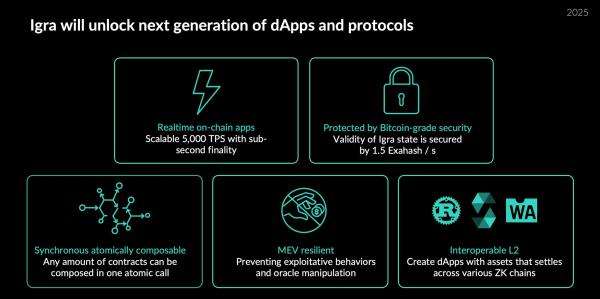
Igra offers full EVM compatibility. Solidity contracts written for Ethereum can be deployed without changes. Atomic composability is preserved, meaning multiple smart contract calls can be executed within a single transaction without partial failure.
This synchronous execution model enables complex DeFi primitives, such as on-chain risk engines, order-book-based decentralized exchanges, and perpetual markets, that rely on deterministic execution across contracts.
Consensus, Finality, and Security Model
Leaderless Consensus Inheritance
Igra leverages Kaspa’s leaderless consensus directly. Kaspa allows multiple miners to produce blocks in parallel, and the BlockDAG merges these blocks into a consistent ordering. There is no elected leader per round, which reduces the attack surface associated with leader selection.
Because Igra does not introduce an additional consensus layer, attacks on the Layer 2 require compromising the underlying Kaspa network. This aligns Igra’s security directly with Kaspa’s Proof-of-Work hashrate.
Finality Characteristics
Transactions on Igra achieve near-instant probabilistic finality once they are mined into Kaspa. With parallel block creation, transaction reversion becomes increasingly difficult as additional blocks are added. For most applications, finality is achieved in sub-second timeframes.
There is no concept of delayed finality or challenge windows at the Layer 2 level. Once sequenced on Kaspa, an Igra transaction is considered final.
Attack Cost and Fault Tolerance
At the time of writing, Kaspa operates with a hashrate exceeding one exahash per second. Executing a majority attack would require substantial capital and sustained coordination. This makes attacks on Igra economically impractical under current network conditions.
Fault tolerance is inherent in the design. If an Igra node fails, users can connect to another node that has correctly replayed the Layer 1 history. Transactions submitted through faulty nodes are ignored once properly sequenced on Kaspa.
Performance and Scalability
Igra’s performance scales with Kaspa’s underlying capabilities. With the upcoming Kaspa Crescendo upgrade, Igra is expected to support approximately 5,000 transactions per second, with the potential for higher throughput as BlockDAG parameters evolve.
Transaction costs consist of the Kaspa Layer 1 fee plus a small Layer 2 execution overhead. Current estimates place the base fee at approximately half a KAS or less per transaction, depending on network conditions.
Because transactions are posted individually rather than in batches, decentralization is preserved and latency is minimized. This design avoids the centralization tradeoffs commonly seen in rollups that rely on sequencer batching.
Multi-Chain Verification and Zero-Knowledge Roadmap
While Igra’s state is secured primarily by Kaspa, the architecture supports publishing zero-knowledge proofs of state transitions to other blockchains such as Ethereum. This enables cross-chain verification and bi-directional asset transfers.
In the current phase, Igra prioritizes fast settlement and scaling without native zero-knowledge verification. Future upgrades plan to integrate zk STARKs or similar proof systems aligned with Kaspa’s planned ZK opcode support.
Once zero-knowledge verification is enabled on Kaspa, Igra will support lightweight clients, pruned nodes, and canonical exits back to Layer 1. This will replace the current multisig-based bridging model with a trustless system.
The iKAS Native Token
Overview
Igra uses iKAS as its gas token. iKAS is a one-to-one wrapped representation of KAS, the native token of Kaspa. The wrapping mechanism is embedded into the Igra protocol and does not rely on a centralized minting authority.
Users lock KAS on Kaspa Layer 1 and receive an equivalent amount of iKAS on Igra. The process is permissionless and enforced by immutable smart contract logic on the Layer 2.
Bridging Mechanics
When a user sends KAS to a designated multisig wallet on Kaspa, Igra nodes detect the transaction and mint iKAS on Igra. This mechanism enables seamless use of KAS for gas and application interactions within the Igra ecosystem.
In the current pre-zero-knowledge phase, exits back to native KAS are not yet enabled. Users can exit the ecosystem through EVM-compatible bridges to other chains, peer-to-peer atomic swaps, or direct use within Igra-based applications. Partners like KAT Bridge enable KAS-iKAS support on mainnet.
Security Model and Signer Commitments
The multisig wallet that secures the locked KAS is controlled by the Igra Foundation DAO. Signers are rotated periodically, and all signers publicly commit to predefined rules. If the zero-knowledge bridge is launched as planned, locked funds will be transferred to automated system wallets that are verified via cryptographic mechanisms.
If the bridge is not implemented within the agreed timeframe or if the Layer 2 becomes non-functional, signers are obligated to return funds to iKAS holders based on the most recent reliable state.
The IGRA Token
The IGRA token is a utility token designed to incentivize node operators, attesters, and validators. It plays a temporary role in securing bridges and encouraging decentralized participation until zero-knowledge verification is fully deployed.
Distribution is tied to network participation, with rewards allocated to those contributing to execution, attestation, and infrastructure resilience. The token is not positioned as a governance abstraction layer that replaces protocol rules; those rules remain enforced by code and Layer 1 consensus.
Developer Experience and Tooling
Igra offers a developer experience that closely mirrors Ethereum. Standard Solidity development workflows are supported, and existing contracts can be deployed without modification.
Developers interact with Igra via familiar JSON-RPC endpoints and tools. Open source components include transaction formats, wallet integrations, and node orchestration scripts.
Because atomic composability is preserved, complex contract systems can be built without asynchronous message passing or fragmented liquidity. This design supports advanced DeFi use cases that rely on real-time execution guarantees.
Ecosystem and Early Integrations
As of early 2026, the Igra ecosystem includes more than 34 active builders across 21 teams. Development focuses on DeFi primitives, NFT marketplaces, and bridging infrastructure.
Notable projects include an NFT marketplace, decentralized exchanges under active testing, lending protocols backed by KAS collateral, and multi-network bridges supporting KAS and iKAS. Explorers and analytics tools have also added native Igra support.
Stablecoins are encouraged but not directly issued by the protocol. The team supports both collateralized and algorithmic designs built by third parties.
Key Highlights and Latest Updates within the Igra Network Ecosystem
The Galleon phase mainnet launched in mid January 2026 as a closed environment for community node operators. Deployment access remains restricted, but testing activity has been high, with thousands of transactions processed during early load tests.
The attestation protocol specifications have been open-sourced, and node orchestration tooling is scheduled for public release. Community engagement remains active, with bounties awarded for on-chain monitoring and testing contributions.
Upcoming milestones include the Fluyt phase with open mainnet access, token generation, and validator distribution, followed by broader DeFi integrations and a fully permissionless launch in March 2026.
Conclusion
Igra Network extends Kaspa’s high-throughput BlockDAG into a programmable execution environment without introducing additional consensus layers or centralized sequencers. By anchoring transaction ordering and finality directly to Kaspa, Igra inherits strong security guarantees, fast settlement, and fault tolerance.
The architecture prioritizes decentralization, atomic composability, and EVM compatibility. While zero-knowledge verification and trustless exits remain under development, the current system demonstrates a functional, based rollup model built on Proof of Work infrastructure.
As Kaspa evolves, Igra provides a concrete example of how programmable layers can be added without compromising base layer principles or relying on centralized intermediaries.
Sources:
- Website: Igra Labs and Igra Network
- X Account: Recent Updates across Igra Network
- Igra Documentation: Architecture, iKAS, and More
