 Bitcoin
  Ethereum
  Tether
  XRP
XRP  BNB
BNB  USDC
USDC  Solana
  TRON
TRON  Lido Staked Ether
  Figure Heloc
  Dogecoin
  WhiteBIT Coin
  USDS
USDS  LEO Token
  Hyperliquid
  Wrapped stETH
  Cardano
  Bitcoin Cash
  Wrapped Bitcoin
  Monero
  Binance Bridged USDT (BNB Smart Chain)
  Chainlink
  Wrapped Beacon ETH
  Canton
  Zcash
Zcash  Stellar
  Wrapped eETH
  MemeCore
  USD1
USD1  sUSDS
sUSDS  Dai
Dai  Litecoin
  Avalanche
  Coinbase Wrapped BTC
  Hedera
  Ethena USDe
  Sui
Sui  WETH
WETH  Shiba Inu
  Rain
Rain  PayPal USD
  USDT0
USDT0  Toncoin
  Cronos
  Circle USYC
  Tether Gold
  Global Dollar
  Bittensor
  World Liberty Financial
  Ethena Staked USDe
  BlackRock USD Institutional Digital Liquidity Fund
  PAX Gold
  Mantle
  Polkadot
  Uniswap
  Sky
Sky  Pi Network
  Falcon USD
  NEAR Protocol
  OKB
OKB  Little Pepe
  HTX DAO
  Aster
Aster  syrupUSDC
  Pepe
Pepe  Ripple USD
  Aave
Aave  USDD
USDD  Janus Henderson Anemoy Treasury Fund
  Bitget Token
  Ondo US Dollar Yield
  Internet Computer
  BFUSD
BFUSD  Ethereum Classic
  Ondo
Ondo  Gate
Gate  KuCoin
  Morpho
  Jupiter Perpetuals Liquidity Provider Token
  Superstate Short Duration U.S. Government Securities Fund (USTB)
  Pump.fun
  United Stables
  Algorand
  Quant
Quant  Jito Staked SOL
  Spiko EU T-Bills Money Market Fund
  Cosmos Hub
  Kelp DAO Restaked ETH
  POL (ex-MATIC)
  Blockchain Capital
  Binance-Peg WETH
  Ethena
  Rocket Pool ETH
  Render
  Kaspa
Kaspa  Binance Bridged USDC (BNB Smart Chain)
  NEXO
NEXO  Worldcoin
  Wrapped BNB
  Stable
  Function FBTC
  Aptos
Aptos  Arbitrum
  JUST
JUST  Provenance Blockchain
  Filecoin
  syrupUSDT
  Flare
Flare  DeXe
DeXe  Jupiter
  Binance Staked SOL
  Pudgy Penguins
  Beldex
  VeChain
  OUSG
OUSG  XDC Network
  USDtb
USDtb  NEW X CEO IS BACK
  Polygon Bridged USDC (Polygon PoS)
  GHO
GHO  Solv Protocol BTC
  Official Trump
  Lombard Staked BTC
  Midnight
  Usual USD
  Bonk
Bonk  clBTC
clBTC  YLDS
YLDS  Siren
Siren  TrueUSD
  A7A5
A7A5  PancakeSwap
  Chiliz
  StakeWise Staked ETH
  edgeX
edgeX  Virtuals Protocol
  Kinetiq Staked HYPE
  Artificial Superintelligence Alliance
  tBTC
tBTC  Dash
Dash  WrappedM by M0
  EURC
EURC  Aerodrome Finance
  Tezos
Tezos  ADI
ADI  Stacks
  First Digital USD
  c8ntinuum
  Janus Henderson Anemoy AAA CLO Fund
  Mantle Staked Ether
  Venice Token
  Sei
Sei  Polygon PoS Bridged DAI (Polygon POS)
  USX
USX  Resolv wstUSR
  Manadia
  COCA
COCA  币安人生 (BinanceLife)
  LayerZero
  Zebec Network
  Doge Strategy
  Liquid Staked ETH
  Injective
  Arbitrum Bridged WBTC (Arbitrum One)
  Ether.fi
  Kinesis Gold
  Sun Token
  Terra Luna Classic
  Wrapped Flare
  Curve DAO
  Monad
Monad  L2 Standard Bridged WETH (Base)
  SPX6900
  Steakhouse USDC Morpho Vault
  Decred
  Lido DAO
  PRIME
PRIME  Gnosis
  Binance-Peg XRP
  Celestia
  Ether.Fi Liquid ETH
  BitTorrent
  Renzo Restaked ETH
  AINFT
AINFT  Bitcoin SV
  Noon
Noon  sBTC
sBTC  Humanity
  FLOKI
FLOKI  Conflux
  Jupiter Staked SOL
  Olympus
  Savings USDD
  DoubleZero
  JasmyCoin
  USDai
USDai  Marinade Staked SOL
  Ape and Pepe
  Arbitrum Bridged WETH (Arbitrum One)
  crvUSD


What is Kaspa?
Kaspa represents a significant evolution in blockchain technology, standing as the fastest, open-source, decentralized, and fully scalableLayer-1 protocol. Unlike traditional blockchains, Kaspa is built on groundbreaking blockDAG technology – a digital ledger that enables parallel blocks and instant transaction confirmation – supported by a robust proof-of-work consensus mechanism with rapid single-second block intervals.
The name “Kaspa” derives from the Aramaic word for “silver” and “money,” symbolizing its position alongsideBitcoin (representing digital gold) as a more fluid, transaction-focused digital asset. While Bitcoin has solidified its role as the ultimate store of value, Kaspa aims to fulfill Satoshi Nakamoto’s original vision: creating a peer-to-peer electronic cash system suitable for everyday transactions.
Kaspa’s Technical Foundation:
At its core, Kaspa implements the GHOSTDAG protocol, a groundbreaking generalization of Nakamoto Consensus. Traditional blockchains like Bitcoin face a fundamental limitation – they must maintain slow block creation rates to prevent “orphan blocks” that occur when network propagation delays cause miners to create competing blocks.
Kaspa’s blockDAG technology solves this limitation by:
- Enabling parallel block creation rather than sequential
- Processing all blocks simultaneously by linking side-chains
- Incorporating “orphan” blocks into the ledger instead of discarding them
- Using a novel greedy algorithm to order blocks, favoring honest, well-connected blocks
The blockDAG architecture overcomes traditional blockchain limitations by processing blocks in parallel and linking all side-chains. This structure dramatically increases block formation rates while maintaining decentralized security.
This architecture allows Kaspa to maintain the security guarantees of Bitcoin while dramatically increasing throughput and reducing confirmation times. The current mainnet operates with one block per second, with plans to dramatically increase this rate following the implementation of the completed Rust rewrite.
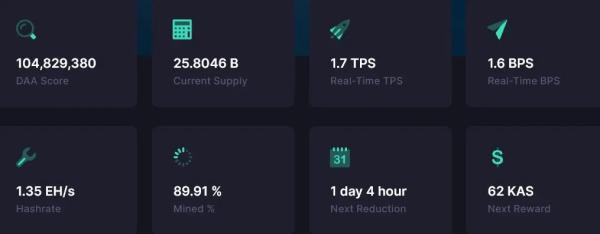
Data on the Kaspa blockchain itself (kas.fyi)
Advanced Technical Features
Kaspa’s implementation includes several technical innovations:
- Reachability: Advanced query capabilities for DAG topology
- Block Data Pruning: Efficient data management with block header pruning
- SPV Proofs: Simplified payment verification for lightweight clients
- Subnetwork Support: Foundations for future Layer 2 solutions
- Cryptographic Receipts: Verifiable proofs of transaction acceptance
- Harmonic Mass Formula: Solution to prevent state bloat attacks
Community-Driven Development
Kaspa stands as a decentralized project with open community participation. The development is led by industry pioneers but involves contributions from community members worldwide:
- 100% open-source code base onGitHub
- Development contributions from a global team spanning 16+ countries
- Transparent development process with community input
This open approach to development aligns with the decentralized ethos of the project.
Rust Rewrite and Performance Breakthrough
Kaspa has undergone an extensive core rewrite in Rust Programming Language, the rewrite known as Rusty-Kaspa has transformed the codebase to enable record efficiency and industry-leading performance while establishing the groundwork forsmart contracts.
The Rusty-Kaspa client was initiated by former DAGLabs developer Michael Sutton and developed by a global team. The implementation is remarkably efficient, allowing high-throughput operation on affordable hardware – full nodes have successfully run on Raspberry Pis, decade-old laptops, and even mid-tier mobile phones.
This rewrite will introduce unprecedented throughput, with initial estimates targeting 32 blocks per second (one block every ~31 milliseconds), with future projections of 100 blocks per second. The rewrite was functionally advanced by Q2 2023 (Testnet 11) but not fully “completed” until later (stable release in 2024).
Kaspa currently maintains two test networks: Testnet 10 (TN-10), which accurately replicates the current mainnet, and Testnet 11, which showcases the Rust implementation. Testnet 11 has run effectively since mid-2023, and now operates between 2400 and 3000 transactions per second over 10 blocks per second. The upcomingCrescendo hard-fork will bring these, among other improvements, to the mainnet.
ZK-Rollups Support
With this enhanced performance, Kaspa is uniquely positioned to handle ZK-rollups, enabling a diverse Layer 2 ecosystem that inherits Kaspa’s security, censorship resistance, and MEV resistance while ensuring L2s remain tied to the main chain.
The GHOSTDAG Protocol and Trilemma Solution
The GHOSTDAG protocol solves the blockchain trilemma by employing a clever system that categorizes blocks as either “Blue” (well-connected) or “Red” (less connected). This approach creates a consistent block ordering that prioritizes honest miners’ contributions while maintaining security against potential attackers.
GHOSTDAG enables three critical improvements over traditional blockchains:
- Security: Maintains Bitcoin’s 51% security threshold while enabling faster blocks
- Scalability: Allows blocks to be created in parallel without compromising network stability
- Decentralization: Reduces mining variance, decreasing the incentive to join large mining pools
The protocol creates a healthier fee market by preventing the typical “race to the bottom” with fees. Even at low network usage (e.g., 11% capacity), the parallel block structure means miners still compete for the same transactions, incentivizing them to prioritize higher-fee transactions while allowing lower-fee transactions a chance of inclusion. This maintains fee incentives even when the network is far from congested.
Tokenomics:
Kaspa started and had a true fair-launch on November 7, 2021, with no premine, no pre-sales, and no allocated coins. The cryptocurrency follows key distribution principles:
- Max Supply: Approximately 28.7 billion KAS
- Circulating Supply: Currently 25.8 billion KAS
- Emission Schedule: Halves once per year via smooth monthly reductions by a factor of (1/2)^(1/12). The current block reward is ±62 KAS
- Fair Mining Evolution: Started with CPUs, expanded to GPUs, FPGAs, and now includes ASICs
Token Distribution
Analysis of Kaspa’s token distribution shows a remarkably balanced ecosystem. Over 70% of addresses hold between 0.01-10K KAS, while mid-sized wallets (1K-100K KAS) contain roughly 30% of circulating supply, forming a strong community foundation.
Large wallets (10M+ KAS) control about 43% of supply—notably lower concentration than comparable projects where often 20 addresses control over 50%. Only 17 addresses hold more than 100M KAS (22.5% of supply); these might be exchange addresses, indicating healthy distribution at the top.
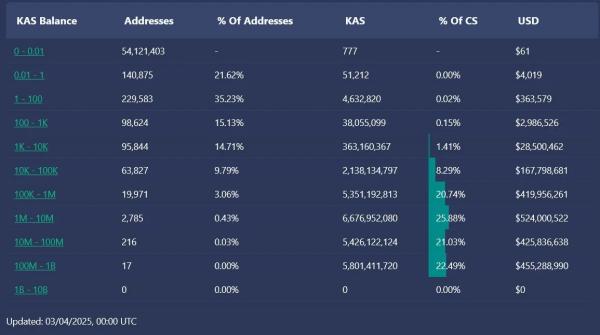
Data on KAS token concentration (kaspa.org)
Conclusion: Beyond the Block
Kaspa represents a fundamental advancement in blockchain technology, successfully addressing the core limitations that have constrained cryptocurrencies since Bitcoin’s inception. By maintaining the security and decentralization principles of Nakamoto’s original design while dramatically improving speed and throughput, Kaspa stands as a genuine realization of the peer-to-peer electronic cash system described in theBitcoin whitepaper.
With one-second block times, ten-second full confirmations, and an open-source approach to development, Kaspa provides the technical foundation needed for cryptocurrency to achieve mainstream adoption for everyday transactions. The project continues to evolve through its Rust implementation and upcoming Crescendo hard-fork, Kaspa could become a cornerstone technology in the blockchain ecosystem.
