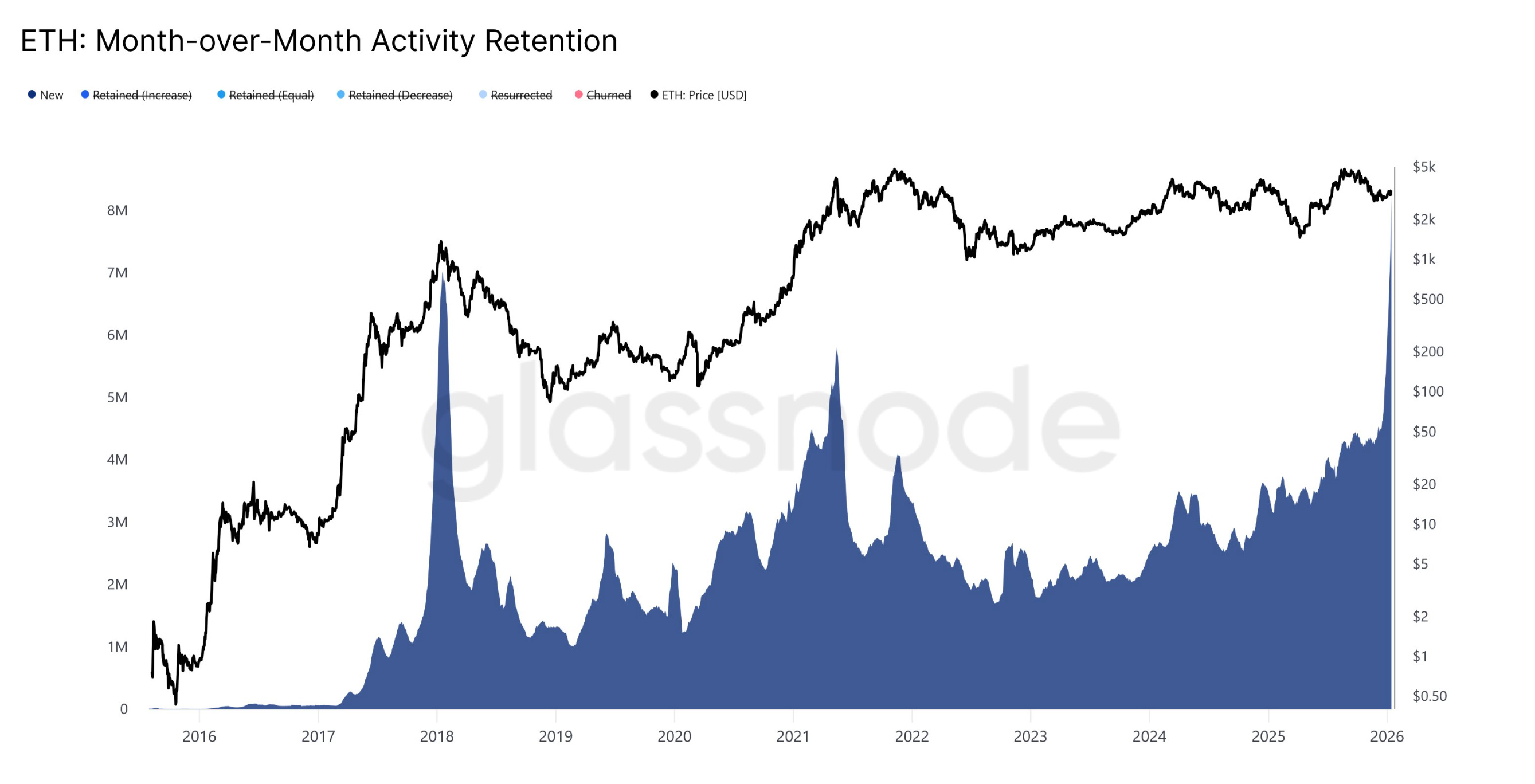
Ethereum activity has picked up sharply over the past month, driven not by existing users doing more, but by a surge in new addresses interacting with the network for the first time.
Data on Ethereum’s month-over-month activity retention shows a pronounced spike in the “new” cohort — a metric that tracks wallets making their first recorded interaction on the blockchain within a given period.
(Glassnode)
The jump over the past 30 days stands out relative to recent months, pointing to fresh participation rather than recycled activity.
That distinction matters. Periods of rising on-chain activity can sometimes reflect the same users moving funds more frequently, especially during volatile markets. A rise led by new wallets, however, suggests broader interest in Ethereum itself — whether through decentralized finance, stablecoin transfers, NFTs, or newer applications built on the network.
The increase comes as ether has stabilized around the $3,300 level and broader crypto sentiment has improved following a volatile end to 2025.
Network usage tends to respond with a lag to price moves, as new participants take time to onboard, fund wallets and interact with applications.
Historically, sustained growth in new Ethereum addresses has coincided with phases where activity expands beyond a narrow set of power users.
That doesn’t guarantee higher prices, but it does point to healthier network engagement than rallies driven purely by leverage or short-term trading.
The key question now is whether these new users stick around. If retention improves in coming months — meaning today’s new wallets continue transacting — it would signal a more durable recovery in Ethereum usage. However, if activity fades quickly, the spike may prove temporary, tied to short-term market excitement rather than lasting adoption.
For now, the data shows Ethereum is attracting new participants again, a shift from the quieter, consolidation-heavy stretch seen through much of last year.
 Bitcoin
  Ethereum
  Tether
  XRP
XRP  BNB
BNB  USDC
USDC  Solana
  TRON
TRON  Lido Staked Ether
  Figure Heloc
  Dogecoin
  WhiteBIT Coin
  USDS
USDS  Hyperliquid
  Cardano
  Wrapped stETH
  LEO Token
  Bitcoin Cash
  Wrapped Bitcoin
  Chainlink
  Binance Bridged USDT (BNB Smart Chain)
  MemeCore
  Wrapped Beacon ETH
  Monero
  Ethena USDe
  Canton
  Wrapped eETH
  Stellar
  Zcash
Zcash  RaveDAO
  sUSDS
sUSDS  Litecoin
  Dai
Dai  Coinbase Wrapped BTC
  Avalanche
  USD1
USD1  PayPal USD
  WETH
WETH  Sui
Sui  Hedera
  Shiba Inu
  USDT0
USDT0  Rain
Rain  Toncoin
  Cronos
  Circle USYC
  Tether Gold
  World Liberty Financial
  BlackRock USD Institutional Digital Liquidity Fund
  Ethena Staked USDe
  Bittensor
  PAX Gold
  Global Dollar
  Polkadot
  Mantle
  Uniswap
  Pi Network
  OKB
OKB  Sky
Sky  NEAR Protocol
  Little Pepe
  Falcon USD
  Aave
Aave  syrupUSDC
  Aster
Aster  Pepe
Pepe  HTX DAO
  USDD
USDD  Janus Henderson Anemoy Treasury Fund
  Ripple USD
  Internet Computer
  Ondo US Dollar Yield
  Ethereum Classic
  Bitget Token
  BFUSD
BFUSD  Ondo
Ondo  Pump.fun
  KuCoin
  Jupiter Perpetuals Liquidity Provider Token
  Gate
Gate  Quant
Quant  Morpho
  Algorand
  Worldcoin
  Jito Staked SOL
  Spiko EU T-Bills Money Market Fund
  Ethena
  Kelp DAO Restaked ETH
  Kaspa
Kaspa  United Stables
  Binance-Peg WETH
  Render
  POL (ex-MATIC)
  Rocket Pool ETH
  Cosmos Hub
  Binance Bridged USDC (BNB Smart Chain)
  NEXO
NEXO  USDtb
USDtb  Wrapped BNB
  Superstate Short Duration U.S. Government Securities Fund (USTB)
  Function FBTC
  Arbitrum
  Aptos
Aptos  Filecoin
  Blockchain Capital
  Official Trump
  syrupUSDT
  Flare
Flare  Jupiter
  XDC Network
  Binance Staked SOL
  VeChain
  Midnight
  Beldex
  Provenance Blockchain
  OUSG
OUSG  GHO
GHO  NEW X CEO IS BACK
  Polygon Bridged USDC (Polygon PoS)
  YLDS
YLDS  Solv Protocol BTC
  Stable
  Lombard Staked BTC
  Bonk
Bonk  DeXe
DeXe  Usual USD
  clBTC
clBTC  JUST
JUST  PancakeSwap
  Artificial Superintelligence Alliance
  Siren
Siren  TrueUSD
  LayerZero
  StakeWise Staked ETH
  Pudgy Penguins
  A7A5
A7A5  Kinetiq Staked HYPE
  Virtuals Protocol
  tBTC
tBTC  Dash
Dash  WrappedM by M0
  ADI
ADI  Stacks
  Chiliz
  EURC
EURC  edgeX
edgeX  First Digital USD
  c8ntinuum
  Venice Token
  Mantle Staked Ether
  Ether.fi
  Tezos
Tezos  Polygon PoS Bridged DAI (Polygon POS)
  Monad
Monad  Janus Henderson Anemoy AAA CLO Fund
  Resolv wstUSR
  COCA
COCA  Sei
Sei  Aerodrome Finance
  USX
USX  Doge Strategy
  Liquid Staked ETH
  PRIME
PRIME  Arbitrum Bridged WBTC (Arbitrum One)
  Kinesis Gold
  Celestia
  Lido DAO
  Decred
  Wrapped Flare
  币安人生 (BinanceLife)
  Sun Token
  L2 Standard Bridged WETH (Base)
  Curve DAO
  Steakhouse USDC Morpho Vault
  Injective
  SPX6900
  AINFT
AINFT  Conflux
  Bitcoin SV
  Binance-Peg XRP
  BitTorrent
  Ether.Fi Liquid ETH
  Gnosis
  Renzo Restaked ETH
  Plasma
  DoubleZero
  Noon
Noon  sBTC
sBTC  FLOKI
FLOKI  USDai
USDai  Kinesis Silver
  Jupiter Staked SOL
  Kaia
Kaia  Savings USDD
  Maple Finance
  Optimism
  JasmyCoin
  Marinade Staked SOL
  The Graph
  Arbitrum Bridged WETH (Arbitrum One)