 Bitcoin
  Ethereum
  Tether
  BNB
BNB  XRP
XRP  USDC
USDC  Solana
  TRON
TRON  Lido Staked Ether
  Figure Heloc
  Dogecoin
  USDS
USDS  WhiteBIT Coin
  Bitcoin Cash
  Hyperliquid
  Wrapped stETH
  Cardano
  LEO Token
  Wrapped Bitcoin
  Chainlink
  Binance Bridged USDT (BNB Smart Chain)
  Monero
  Wrapped Beacon ETH
  Ethena USDe
  Stellar
  Canton
  Wrapped eETH
  USD1
USD1  Dai
Dai  sUSDS
sUSDS  Litecoin
  Rain
Rain  PayPal USD
  Coinbase Wrapped BTC
  Hedera
  Avalanche
  MemeCore
  WETH
WETH  Zcash
Zcash  Sui
Sui  Shiba Inu
  USDT0
USDT0  Bittensor
  Cronos
  Toncoin
  World Liberty Financial
  Circle USYC
  Tether Gold
  PAX Gold
  Ethena Staked USDe
  Mantle
  Uniswap
  Polkadot
  BlackRock USD Institutional Digital Liquidity Fund
  Global Dollar
  Falcon USD
  OKB
OKB  Pi Network
  Sky
Sky  Aster
Aster  HTX DAO
  syrupUSDC
  Aave
Aave  NEAR Protocol
  Ripple USD
  Pepe
Pepe  Bitget Token
  Ondo US Dollar Yield
  BFUSD
BFUSD  Ondo
Ondo  Ethereum Classic
  Internet Computer
  Gate
Gate  Janus Henderson Anemoy Treasury Fund
  Quant
Quant  KuCoin
  Pump.fun
  Jupiter Perpetuals Liquidity Provider Token
  POL (ex-MATIC)
  Spiko EU T-Bills Money Market Fund
  Kaspa
Kaspa  Render
  USDtb
USDtb  Jito Staked SOL
  NEXO
NEXO  Worldcoin
  Kelp DAO Restaked ETH
  Morpho
  Cosmos Hub
  Binance-Peg WETH
  Ethena
  Rocket Pool ETH
  USDD
USDD  Aptos
Aptos  Binance Bridged USDC (BNB Smart Chain)
  Midnight
  Superstate Short Duration U.S. Government Securities Fund (USTB)
  Wrapped BNB
  Algorand
  Function FBTC
  Provenance Blockchain
  Official Trump
  Flare
Flare  Filecoin
  Beldex
  syrupUSDT
  OUSG
OUSG  XDC Network
  Siren
Siren  Binance Staked SOL
  YLDS
YLDS  GHO
GHO  VeChain
  Usual USD
  Arbitrum
  Stable
  Polygon Bridged USDC (Polygon PoS)
  Artificial Superintelligence Alliance
  Solv Protocol BTC
  JUST
JUST  Lombard Staked BTC
  LayerZero
  Bonk
Bonk  Jupiter
  clBTC
clBTC  TrueUSD
  Fasttoken
  A7A5
A7A5  PancakeSwap
  Virtuals Protocol
  EURC
EURC  StakeWise Staked ETH
  Pudgy Penguins
  Stacks
  Kinetiq Staked HYPE
  tBTC
tBTC  Dash
Dash  First Digital USD
  WrappedM by M0
  Janus Henderson Anemoy AAA CLO Fund
  Tezos
Tezos  Sei
Sei  Decred
  Ether.fi
  c8ntinuum
  Kite
Kite  PRIME
PRIME  Mantle Staked Ether
  Chiliz
  USX
USX  Polygon PoS Bridged DAI (Polygon POS)
  DeXe
DeXe  Resolv wstUSR
  Kinesis Gold
  COCA
COCA  Sun Token
  AINFT
AINFT  Curve DAO
  Liquid Staked ETH
  ADI
ADI  Arbitrum Bridged WBTC (Arbitrum One)
  BitTorrent
  Gnosis
  USDai
USDai  Conflux
  Wrapped Flare
  Aerodrome Finance
  River
River  L2 Standard Bridged WETH (Base)
  Injective
  Steakhouse USDC Morpho Vault
  Kaia
Kaia  Legacy Frax Dollar
  Celestia
  FLOKI
FLOKI  Bitcoin SV
  Binance-Peg XRP
  JasmyCoin
  Ether.Fi Liquid ETH
  Venice Token
  Renzo Restaked ETH
  Official FO
  crvUSD
  sBTC
sBTC  Kinesis Silver
  SPX6900
  Ape and Pepe
  Jupiter Staked SOL
  The Graph
  Savings USDD
  Maple Finance
  DoubleZero
  Monad
Monad  Marinade Staked SOL
  Olympus
  Arbitrum Bridged WETH (Arbitrum One)
  IOTA
IOTA  Lido DAO
  BTSE Token
  TheTrumpToken


Ethereum is attempting to stabilize around the $2,000 level as the broader crypto market enters a critical consolidation phase following weeks of heightened volatility. Price action remains fragile, with buyers defending key psychological support while macro uncertainty, liquidity shifts, and persistent selling pressure continue to weigh on sentiment. Analysts note that the current environment resembles previous transitional periods where market structure weakened before a clearer directional move emerged.
A recent CryptoQuant report highlights an important contrast in exchange-flow dynamics between Bitcoin and Ethereum. According to the data, significant amounts of Bitcoin have recently been deposited onto exchanges, pushing exchange-held BTC supply back to levels last seen around 2019. However, a notable portion of this supply appears to belong to investors who simply custody assets on exchanges rather than actively preparing to sell, making interpretation less straightforward.
Ethereum presents a different picture. Despite launching in 2015 and expanding dramatically since then, the amount of $ETH held on exchanges currently mirrors levels observed around mid-2016. This unusually low exchange supply suggests a tighter liquid float, potentially reflecting increased long-term holding, staking participation, or DeFi deployment, all of which could influence future price dynamics.
Exchange Supply Tightening Signals Potential Liquidity Shift
The CryptoQuant report provides additional context on Ethereum’s exchange supply dynamics by highlighting a historical comparison. In the referenced chart, the red box marks the current amount of $ETH held on exchanges, while the blue box reflects a similar spot supply level last seen around mid-2016. Despite Ethereum’s substantial growth in adoption, liquidity, and institutional participation since then, exchange balances remain unusually low.
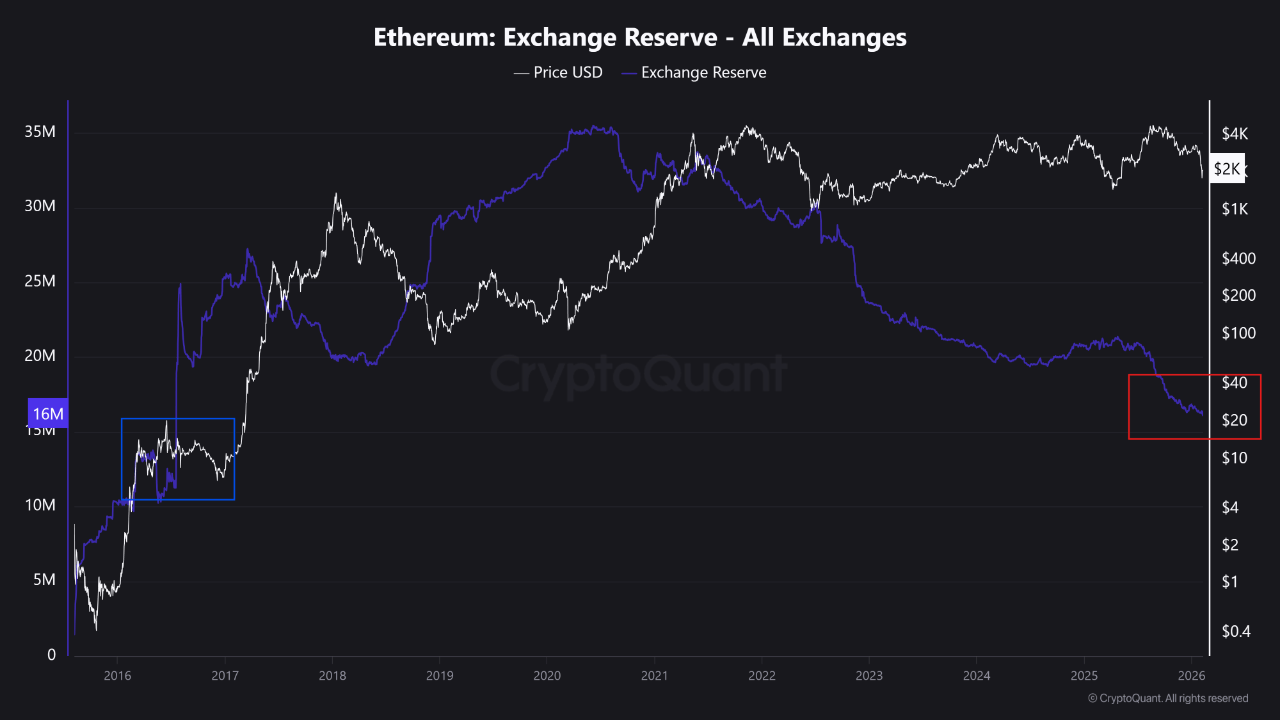
However, because a significant portion of this $ETH still belongs to investors rather than active traders, it remains uncertain whether such constrained exchange supply can persist over time. This makes ongoing monitoring of exchange inflows and outflows particularly relevant for assessing future price stability.
The report also notes that Ethereum’s over-the-counter (OTC) balances have increased recently. Even so, this liquidity pool remains relatively modest compared with exchange-held supply. Limiting its ability to fully offset sudden demand shocks or selling waves. If exchange balances were to tighten further while OTC liquidity also declined, the market could face sharper price reactions to incremental demand changes.
Such a scenario raises structural questions about market dynamics. Reduced immediately available supply could amplify volatility, intensify short squeezes, or accelerate price discovery phases, depending on broader macro sentiment and capital flows.
Ethereum Tests Critical Support as Bearish Momentum Persists
Ethereum continues to trade under sustained pressure after losing key support levels and briefly testing the $2,000 zone. A psychological threshold that now defines the short-term battlefield between buyers and sellers. The chart shows a clear deterioration in market structure since late 2025, with $ETH consistently printing lower highs while repeatedly failing to reclaim its major moving averages. Price currently sits below the 50-, 100-, and 200-period averages, confirming a firmly bearish trend.
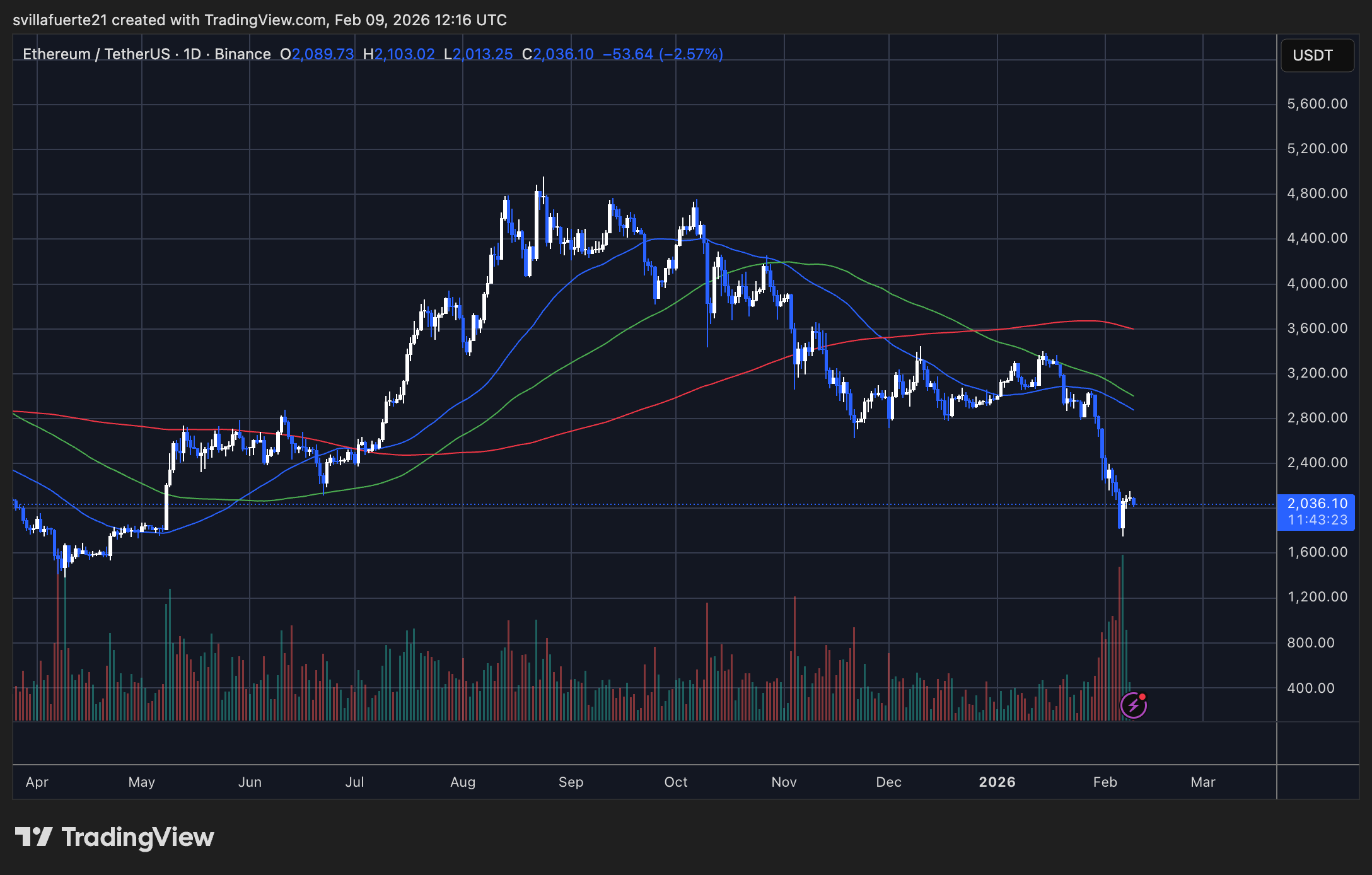
The recent breakdown accelerated as volume expanded sharply, suggesting forced selling rather than orderly repositioning. This kind of volume spike often accompanies liquidation cascades or defensive portfolio adjustments, particularly in derivatives-heavy environments. Notably, the bounce from the lows remains modest, indicating limited immediate demand absorption.
From a technical standpoint, the $2,000–$2,100 region now acts as fragile support. Losing it decisively could expose $ETH to deeper retracement levels around $1,700 or even the $1,500 zone. Where previous consolidation occurred. Conversely, stabilization above this range would be the first signal that selling pressure is easing.
Momentum indicators favor caution. Until Ethereum reclaims key moving averages and establishes higher lows, the broader structure suggests continued consolidation with downside risk still present.
Featured image from ChatGPT, chart from TradingView.com
