 Bitcoin
  Ethereum
  Tether
  BNB
BNB  XRP
XRP  USDC
USDC  Solana
  TRON
TRON  Lido Staked Ether
  Figure Heloc
  Dogecoin
  USDS
USDS  WhiteBIT Coin
  Bitcoin Cash
  Hyperliquid
  Wrapped stETH
  Cardano
  LEO Token
  Wrapped Bitcoin
  Monero
  Binance Bridged USDT (BNB Smart Chain)
  Chainlink
  Wrapped Beacon ETH
  Canton
  Ethena USDe
  Stellar
  Wrapped eETH
  USD1
USD1  Dai
Dai  sUSDS
sUSDS  Litecoin
  MemeCore
  PayPal USD
  Coinbase Wrapped BTC
  Hedera
  Rain
Rain  Avalanche
  WETH
WETH  Zcash
Zcash  Shiba Inu
  Sui
Sui  USDT0
USDT0  Bittensor
  Toncoin
  Cronos
  World Liberty Financial
  Circle USYC
  Tether Gold
  PAX Gold
  Ethena Staked USDe
  Mantle
  BlackRock USD Institutional Digital Liquidity Fund
  Uniswap
  Polkadot
  Global Dollar
  Pi Network
  OKB
OKB  Falcon USD
  Aster
Aster  Sky
Sky  HTX DAO
  syrupUSDC
  NEAR Protocol
  Aave
Aave  Ripple USD
  Pepe
Pepe  Bitget Token
  BFUSD
BFUSD  Ondo US Dollar Yield
  Ondo
Ondo  Ethereum Classic
  Internet Computer
  Siren
Siren  Gate
Gate  Janus Henderson Anemoy Treasury Fund
  KuCoin
  Quant
Quant  Jupiter Perpetuals Liquidity Provider Token
  Pump.fun
  POL (ex-MATIC)
  Kaspa
Kaspa  Spiko EU T-Bills Money Market Fund
  NEXO
NEXO  Jito Staked SOL
  USDtb
USDtb  Render
  Kelp DAO Restaked ETH
  Worldcoin
  Cosmos Hub
  Binance-Peg WETH
  Morpho
  Rocket Pool ETH
  Midnight
  USDD
USDD  Binance Bridged USDC (BNB Smart Chain)
  Ethena
  Superstate Short Duration U.S. Government Securities Fund (USTB)
  Wrapped BNB
  Aptos
Aptos  Function FBTC
  Algorand
  Official Trump
  Flare
Flare  OUSG
OUSG  Filecoin
  syrupUSDT
  XDC Network
  Beldex
  YLDS
YLDS  Binance Staked SOL
  GHO
GHO  Provenance Blockchain
  VeChain
  Usual USD
  Arbitrum
  NEW X CEO IS BACK
  Stable
  Polygon Bridged USDC (Polygon PoS)
  Artificial Superintelligence Alliance
  Solv Protocol BTC
  JUST
JUST  Lombard Staked BTC
  Jupiter
  LayerZero
  Bonk
Bonk  clBTC
clBTC  TrueUSD
  A7A5
A7A5  Fasttoken
  PancakeSwap
  Virtuals Protocol
  EURC
EURC  StakeWise Staked ETH
  Chiliz
  Dash
Dash  Kinetiq Staked HYPE
  tBTC
tBTC  Stacks
  Pudgy Penguins
  WrappedM by M0
  First Digital USD
  Janus Henderson Anemoy AAA CLO Fund
  Tezos
Tezos  Ether.fi
  Decred
  c8ntinuum
  PRIME
PRIME  Sei
Sei  Mantle Staked Ether
  USX
USX  DeXe
DeXe  Polygon PoS Bridged DAI (Polygon POS)
  Kinesis Gold
  Resolv wstUSR
  Sun Token
  COCA
COCA  ADI
ADI  AINFT
AINFT  Doge Strategy
  Curve DAO
  Liquid Staked ETH
  Gnosis
  Arbitrum Bridged WBTC (Arbitrum One)
  BitTorrent
  USDai
USDai  Aerodrome Finance
  Conflux
  Wrapped Flare
  Kite
Kite  Injective
  L2 Standard Bridged WETH (Base)
  Bitcoin SV
  Steakhouse USDC Morpho Vault
  Kaia
Kaia  Legacy Frax Dollar
  River
River  FLOKI
FLOKI  JasmyCoin
  Binance-Peg XRP
  crvUSD
  Ether.Fi Liquid ETH
  Venice Token
  Renzo Restaked ETH
  Celestia
  Official FO
  Noon
Noon  sBTC
sBTC  Kinesis Silver
  Lido DAO
  The Graph
  Jupiter Staked SOL
  SPX6900
  Savings USDD
  Monad
Monad  Ape and Pepe
  Olympus
  Marinade Staked SOL
  IOTA
IOTA  Arbitrum Bridged WETH (Arbitrum One)
  DoubleZero


Crypto has spent years building yield infrastructure, such as staking on Ethereum and Solana, yield-bearing stablecoins, DeFi lending protocols, and tokenized Treasuries.
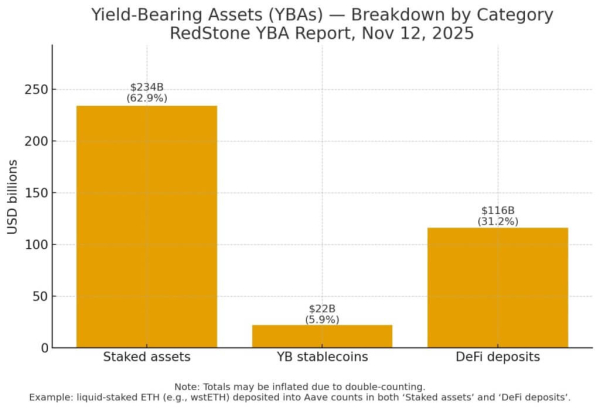
The pipes already exist, the APYs are live, yet only 8% to 11% of the total crypto market generates yield today, compared to 55% to 65% of traditional financial (TradFi) assets, according to RedStone’s latest analysis.
That penetration gap isn’t a product problem, but rather a disclosure problem.
RedStone tallies roughly $300 billion to $400 billion of yield-bearing crypto assets against a $3.55 trillion total market capitalization to arrive at that 8% to 11% figure, with a caveat: the share is likely overstated because some positions get counted twice when staked assets are also deposited in DeFi protocols.
The comparison benchmark encompasses a wide range of investments, including corporate bonds, dividend equities, money-market funds, and structured credit.
TradFi’s advantage isn’t exotic instruments. It’s a century of standardized risk ratings, mandatory disclosure rules, and stress-testing frameworks that let institutions compare yield products on comparable terms.
Crypto has the products, but not the comparability, and that mismatch keeps institutional capital on the sidelines, even when yields run double digits.
Policy as catalyst, not solution
The GENIUS Act established a federal framework for payment stablecoins, requiring full reserve backing and oversight under the Bank Secrecy Act.
RedStone pointed to that clarity as the catalyst behind roughly 300% year-over-year growth in yield-bearing stablecoins, a segment that had stalled under regulatory uncertainty.
The law doesn’t mandate risk transparency, but addresses reserve composition and compliance, removing the binary question of whether stablecoins could operate in a legal gray zone.
That shift allowed issuers and platforms to move from “is this allowed?” to “how do we scale this?” and created the conditions for institutions to start asking more challenging questions about asset quality, collateral chains, and counterparty risk.
Independent coverage of the Act reflects a similar dynamic: regulation reduces uncertainty, but institutions still require more robust risk metrics before scaling up allocations. The law is necessary but not sufficient.
What’s missing is the apparatus that enables a treasury desk or asset manager to compare the risk-adjusted return of a yield-bearing stablecoin to that of a money-market fund, or to evaluate the credit exposure of a DeFi lending pool against a corporate bond ladder.
TradFi has that apparatus, with credit ratings, prospectuses, stress scenarios, and liquidity buckets. Crypto has APY leaderboards and TVL dashboards, which indicate where yield is generated, but not what risks underpin it.
Transparency deficit
RedStone’s analysis distills the problem into a single line: “The barrier to institutional adoption at scale is risk transparency.”
Unpack what that means in practice. First, there’s no comparable risk scoring across yield products. A 5% yield on staked ETH carries different liquidity, slashing, and smart contract risks than a 5% yield on a stablecoin backed by short-term Treasuries.
However, no standardized framework exists to quantify these differences.
Second, asset-quality breakdowns remain inconsistent. DeFi protocols disclose collateral ratios and liquidation thresholds, but tracking rehypothecation requires piecing together on-chain forensics and off-chain custodian reports.
Third, oracle and validator dependencies are rarely disclosed with the rigor TradFi applies to operational risk.
A yield product that depends on a single price feed or a small validator set carries concentration risk that isn’t surfaced in user-facing dashboards.
Then there’s the double-counting issue that RedStone explicitly flags. When staked ETH is wrapped, deposited into a lending protocol, and then used as collateral for another position, TVL metrics increase, and “yield-bearing” percentages overstate the actual capital deployed.
Traditional finance accounting rules separate principal from derivative exposure. Crypto’s on-chain transparency creates the opposite problem, with everything being visible, but aggregating it into meaningful risk metrics requires infrastructure that doesn’t yet exist at scale.
Closing the gap
The next leg isn’t about inventing new yield products. Staked blue chip assets, yield-bearing stablecoins, and tokenized government debt already cover the risk spectrum, ranging from variable to fixed, and from decentralized to custodial.
What’s needed is the measurement layer: standardized risk disclosures, third-party audits of collateral and counterparty exposure, and uniform treatment of rehypothecation and double-counting in reported metrics.
That’s not a technical problem, since on-chain data is auditable by design, but it requires coordination across issuers, platforms, and auditors to build frameworks that institutions recognize as credible.
Crypto’s yield pipes now exist. Staking on proof-of-stake networks delivers predictable returns tied to network security. Yield-bearing stablecoins offer dollar-denominated income with varying degrees of reserve transparency.
DeFi protocols offer variable rates that are driven by the supply and demand for specific assets. The 8% to 11% penetration rate isn’t a signal that crypto lacks yield opportunities.
It’s a signal that the risk attached to those opportunities isn’t legible to the allocators who control the bulk of global capital.
TradFi’s yield penetration didn’t emerge because traditional assets are inherently safer, but rather because their risks are measured, disclosed, and comparable.
Until crypto builds that measurement layer, the adoption bottleneck won’t be product gaps or regulatory ambiguity, but the inability to answer what is at risk for the yield.
