DeFi platforms have opposed the plans to ban stablecoin yield via third-party apps.
In a comment to the OCC (Office of the Comptroller of the Currency), Phantom Wallet and Consensys slammed the agency for going against the stablecoin law, the $GENIUS Act.
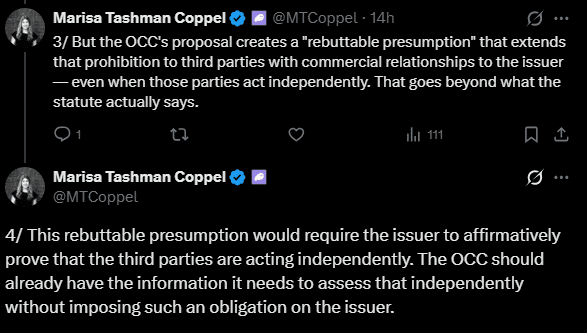
Marisa Tashman Coppel, assistant general counsel at Phantom, argued that the $GENIUS Act only bans stablecoin issuers from offering interest. This is meant to prevent them from functioning as uninsured deposits.
However, she added that the OCC’s proposal to extend the ban to third parties goes ‘beyond what the statute says.’
The OCC’s anti-evasion authority doesn’t give it a blank check to rope in unrelated parties acting on their own commercial judgment.
Source: X
Stablecoin yield fight extends to the $GENIUS Act
Here, critics argue that stablecoins deposited in DeFi are active investments. So if the user puts $USDC into a venue like Aave, the yield accrued is from the DeFi venue.
Similar to other deposited assets, like BTC, it comes with risk. So the yield is not from Circle, the issuer of $USDC.
As such, third parties, especially DeFi platforms with such arrangements aimed at competing for customers, shouldn’t be targeted. Consensys, the firm behind the MetaMask wallet, supported the Phantom, noting that,
The $GENIUS Act itself carves non-custodial software interfaces out of regulated intermediary status. The final rule should confirm this applies to DeFi access as well.
Consensys called for the OCC to differentiate between ‘user incentives’ and ‘yield,’ adding that,
Congress drew this line deliberately, and twice rejected amendments that would have extended the prohibition to non-issuers. The OCC’s rule should respect that line.
The $GENIUS Act was passed into law last July and should be implemented by July this year. Relevant regulators, including the OCC, have begun rulemaking to beat the deadline.
However, the stablecoin yield issue, which has derailed the broader crypto market structure bill, the CLARITY Act, is now being raised during the rulemaking process of the $GENIUS Act.
For banks, this was good news. In their letter to OCC, the American Bankers Association (ABA) said,
The OCC should issue a broad prohibition because Congress required one, and because the evidence shows that anything less will not work.
In part, this is why the crypto industry accepted the recent stablecoin yield compromise. For the sector, the deal would still have the interest via third parties intact. Whether the latest update will be a deal breaker remains to be seen.
Final Summary
Phantom and Consensys have slammed the OCC for overreach amid a proposed broader ban on stablecoin yield on third parties.
Bankers are supporting OCC’s broader stablecoin yield prohibition, warning that ‘anything less will not work.’
 Bitcoin
  Ethereum
  Tether
  XRP
XRP  BNB
BNB  USDC
USDC  Solana
  TRON
TRON  Lido Staked Ether
  Figure Heloc
  Dogecoin
  WhiteBIT Coin
  USDS
USDS  Hyperliquid
  LEO Token
  Wrapped stETH
  Cardano
  Bitcoin Cash
  Wrapped Bitcoin
  Monero
  Binance Bridged USDT (BNB Smart Chain)
  Chainlink
  Wrapped Beacon ETH
  Zcash
Zcash  Canton
  Stellar
  Wrapped eETH
  USD1
USD1  Dai
Dai  sUSDS
sUSDS  Litecoin
  Avalanche
  Ethena USDe
  Coinbase Wrapped BTC
  MemeCore
  Hedera
  Sui
Sui  WETH
WETH  Shiba Inu
  Rain
Rain  Toncoin
  USDT0
USDT0  PayPal USD
  Cronos
  Circle USYC
  Bittensor
  Tether Gold
  Global Dollar
  BlackRock USD Institutional Digital Liquidity Fund
  Ethena Staked USDe
  PAX Gold
  Mantle
  Uniswap
  Polkadot
  Sky
Sky  Pi Network
  World Liberty Financial
  OKB
OKB  Falcon USD
  Aster
Aster  Little Pepe
  HTX DAO
  Pepe
Pepe  syrupUSDC
  NEAR Protocol
  Ripple USD
  USDD
USDD  Aave
Aave  Bitget Token
  Ondo
Ondo  Ethereum Classic
  BFUSD
BFUSD  Ondo US Dollar Yield
  Janus Henderson Anemoy Treasury Fund
  Internet Computer
  Morpho
  KuCoin
  Algorand
  Jupiter Perpetuals Liquidity Provider Token
  POL (ex-MATIC)
  United Stables
  Superstate Short Duration U.S. Government Securities Fund (USTB)
  Quant
Quant  Spiko EU T-Bills Money Market Fund
  Jito Staked SOL
  Blockchain Capital
  Cosmos Hub
  Kelp DAO Restaked ETH
  Kaspa
Kaspa  Render
  Binance-Peg WETH
  NEXO
NEXO  Rocket Pool ETH
  Ethena
  Gate
Gate  Binance Bridged USDC (BNB Smart Chain)
  Aptos
Aptos  Worldcoin
  Wrapped BNB
  Stable
  Function FBTC
  JUST
JUST  Arbitrum
  Filecoin
  Pump.fun
  Flare
Flare  syrupUSDT
  Beldex
  VeChain
  Pudgy Penguins
  Binance Staked SOL
  OUSG
OUSG  Provenance Blockchain
  Jupiter
  GHO
GHO  XDC Network
  USDtb
USDtb  NEW X CEO IS BACK
  Polygon Bridged USDC (Polygon PoS)
  Usual USD
  Solv Protocol BTC
  Bonk
Bonk  Lombard Staked BTC
  Official Trump
  YLDS
YLDS  Midnight
  clBTC
clBTC  MegaUSD
  Siren
Siren  TrueUSD
  Dash
Dash  A7A5
A7A5  Virtuals Protocol
  StakeWise Staked ETH
  PancakeSwap
  DeXe
DeXe  Kinetiq Staked HYPE
  Terra Luna Classic
  tBTC
tBTC  Artificial Superintelligence Alliance
  WrappedM by M0
  BUILDon
  EURC
EURC  edgeX
edgeX  Venice Token
  ADI
ADI  Chiliz
  c8ntinuum
  Aerodrome Finance
  Mantle Staked Ether
  Stacks
  币安人生 (BinanceLife)
  Polygon PoS Bridged DAI (Polygon POS)
  Janus Henderson Anemoy AAA CLO Fund
  First Digital USD
  Resolv wstUSR
  COCA
COCA  Tezos
Tezos  Sei
Sei  USX
USX  Doge Strategy
  Liquid Staked ETH
  Injective
  Arbitrum Bridged WBTC (Arbitrum One)
  Sun Token
  Manadia
  Gnosis
  Curve DAO
  Wrapped Flare
  Monad
Monad  LayerZero
  L2 Standard Bridged WETH (Base)
  Ether.fi
  Steakhouse USDC Morpho Vault
  SPX6900
  Humanity
  Kinesis Gold
  SkyAI
SkyAI  Decred
  Binance-Peg XRP
  PRIME
PRIME  Ether.Fi Liquid ETH
  Celestia
  Renzo Restaked ETH
  BitTorrent
  Bitcoin SV
  Noon
Noon  sBTC
sBTC  Zebec Network
  Conflux
  AINFT
AINFT  Jupiter Staked SOL
  Lido DAO
  Savings USDD
  FLOKI
FLOKI  USDGO
USDGO  crvUSD
  Marinade Staked SOL
  Olympus
  Arbitrum Bridged WETH (Arbitrum One)