 Bitcoin
  Ethereum
  Tether
  XRP
XRP  BNB
BNB  USDC
USDC  Solana
  TRON
TRON  Lido Staked Ether
  Figure Heloc
  Dogecoin
  WhiteBIT Coin
  USDS
USDS  Hyperliquid
  LEO Token
  Wrapped stETH
  Cardano
  Bitcoin Cash
  Wrapped Bitcoin
  Chainlink
  Binance Bridged USDT (BNB Smart Chain)
  Monero
  Wrapped Beacon ETH
  Zcash
Zcash  Canton
  Stellar
  Wrapped eETH
  MemeCore
  Dai
Dai  sUSDS
sUSDS  USD1
USD1  Litecoin
  Avalanche
  Coinbase Wrapped BTC
  Hedera
  Ethena USDe
  Sui
Sui  WETH
WETH  Shiba Inu
  Rain
Rain  PayPal USD
  USDT0
USDT0  Toncoin
  Cronos
  Circle USYC
  Tether Gold
  Bittensor
  Global Dollar
  World Liberty Financial
  Ethena Staked USDe
  PAX Gold
  BlackRock USD Institutional Digital Liquidity Fund
  Mantle
  Polkadot
  Uniswap
  Sky
Sky  NEAR Protocol
  Falcon USD
  OKB
OKB  Pi Network
  Little Pepe
  HTX DAO
  Aster
Aster  syrupUSDC
  Pepe
Pepe  Ripple USD
  Aave
Aave  Janus Henderson Anemoy Treasury Fund
  USDD
USDD  Bitget Token
  Internet Computer
  Ondo US Dollar Yield
  Ethereum Classic
  BFUSD
BFUSD  Ondo
Ondo  KuCoin
  Gate
Gate  Morpho
  Jupiter Perpetuals Liquidity Provider Token
  Pump.fun
  Spiko EU T-Bills Money Market Fund
  Cosmos Hub
  Quant
Quant  Algorand
  Jito Staked SOL
  United Stables
  Superstate Short Duration U.S. Government Securities Fund (USTB)
  Kelp DAO Restaked ETH
  POL (ex-MATIC)
  Ethena
  Binance-Peg WETH
  Render
  Rocket Pool ETH
  Kaspa
Kaspa  NEXO
NEXO  Binance Bridged USDC (BNB Smart Chain)
  Worldcoin
  Arbitrum
  Wrapped BNB
  Aptos
Aptos  Function FBTC
  Blockchain Capital
  Filecoin
  Stable
  JUST
JUST  Flare
Flare  syrupUSDT
  VeChain
  DeXe
DeXe  Beldex
  Binance Staked SOL
  Jupiter
  Midnight
  OUSG
OUSG  XDC Network
  Provenance Blockchain
  Official Trump
  NEW X CEO IS BACK
  Polygon Bridged USDC (Polygon PoS)
  USDtb
USDtb  Solv Protocol BTC
  GHO
GHO  Lombard Staked BTC
  Usual USD
  Bonk
Bonk  YLDS
YLDS  clBTC
clBTC  Pudgy Penguins
  Chiliz
  Siren
Siren  TrueUSD
  PancakeSwap
  A7A5
A7A5  StakeWise Staked ETH
  Artificial Superintelligence Alliance
  edgeX
edgeX  Kinetiq Staked HYPE
  Virtuals Protocol
  tBTC
tBTC  Dash
Dash  WrappedM by M0
  EURC
EURC  ADI
ADI  Stacks
  Venice Token
  First Digital USD
  Sei
Sei  c8ntinuum
  Janus Henderson Anemoy AAA CLO Fund
  Mantle Staked Ether
  Tezos
Tezos  Aerodrome Finance
  Polygon PoS Bridged DAI (Polygon POS)
  LayerZero
  Resolv wstUSR
  Kinesis Gold
  COCA
COCA  USX
USX  币安人生 (BinanceLife)
  Ether.fi
  Doge Strategy
  Liquid Staked ETH
  Monad
Monad  Arbitrum Bridged WBTC (Arbitrum One)
  Injective
  Sun Token
  SPX6900
  Decred
  Wrapped Flare
  Curve DAO
  Zebec Network
  L2 Standard Bridged WETH (Base)
  PRIME
PRIME  Steakhouse USDC Morpho Vault
  Gnosis
  Olympus
  Lido DAO
  Conflux
  Celestia
  Binance-Peg XRP
  AINFT
AINFT  Ether.Fi Liquid ETH
  Bitcoin SV
  Renzo Restaked ETH
  BitTorrent
  FLOKI
FLOKI  Noon
Noon  sBTC
sBTC  crvUSD
  DoubleZero
  Kinesis Silver
  Jupiter Staked SOL
  Kaia
Kaia  Savings USDD
  JasmyCoin
  USDai
USDai  Terra Luna Classic
  Marinade Staked SOL
  Pyth Network
  Arbitrum Bridged WETH (Arbitrum One)


Four newly created wallets withdrew 10M $ASTER worth $6.71M from Binance, shifting a notable portion of supply away from exchange liquidity pools.
The movement reflected a clear redistribution from centralized venues into private custody, reducing immediately available tokens for sale.
As a result, exchange-side pressure had eased, creating a tighter circulating supply environment for $ASTER. However, the use of newly created wallets introduced uncertainty around intent, as such activity could reflect accumulation or strategic repositioning.
The scale of this withdrawal highlighted deliberate coordination, which suggested that large participants had actively repositioned capital rather than reacting passively to market conditions.
Outflows persist but begin stabilizing
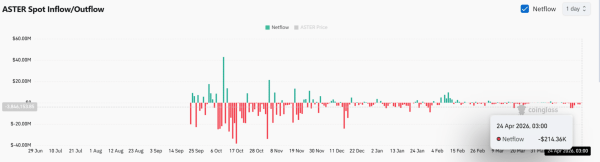
$ASTER Spot flows had remained negative, with the latest netflow printing at -$214.36K, reinforcing continued exchange outflows over the observed period.
Earlier phases had shown deeper outflows, which indicated stronger accumulation behavior compared to the current moderation.
As flows moved closer to neutral, the intensity of supply reduction had started fading, suggesting that aggressive accumulation may have slowed.
However, netflows still pointed toward more tokens leaving exchanges than entering, which maintained a supportive structure beneath the price.
This transition from strong outflows to stabilization reflected a shift from active accumulation into a holding phase, where participants appeared to wait for clearer directional signals.
Source: CoinGlass
Inverse structure builds near key breakout
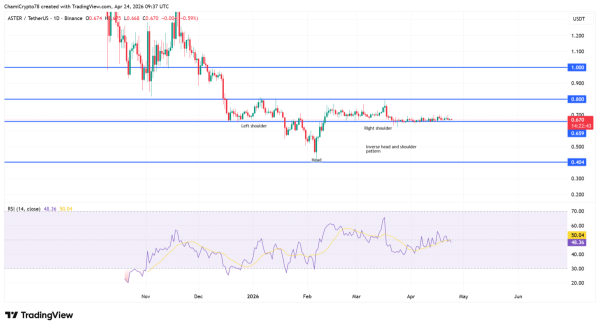
$ASTER had established a broader range between $0.659 support and $0.80 resistance, with price consolidating within these boundaries after recovering from the $0.404 low.
The inverse head and shoulders structure had formed within this range, but price had not yet broken above the upper boundary.
Instead, price had continued rotating between support and resistance, confirming a range-bound structure rather than a breakout trend. Repeated rejections below $0.80 showed that sellers had remained active at higher levels, while support at $0.659 had continued holding.
This behavior reflected equilibrium, where both buyers and sellers had absorbed liquidity without establishing dominance.
The Relative Strength Index had hovered near 48.36, remaining just below the 50 midpoint and reflecting balanced market conditions.
This positioning showed that neither buyers nor sellers had dominated the trend, despite the recovery from lower levels.
Earlier dips into weaker zones had reversed, but RSI had not extended into stronger territory. This indicated limited follow-through from buyers.
Source: TradingView
$ASTER traders lean long as bias strengthens
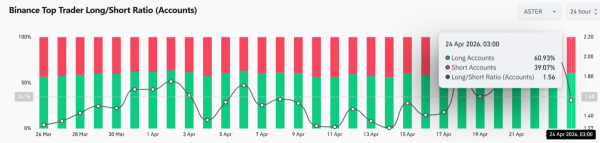
Binance top traders had leaned long, with 60.93% of accounts positioned on the upside compared to 39.07% on the short side, pushing the Long/Short Ratio to 1.56.
This imbalance highlighted a clear directional bias among leveraged participants, as more traders had anticipated upward price movement. However, price had not responded with a breakout, which created a disconnect between positioning and structure.
Elevated long exposure without confirmation from price often increases the risk of volatility, particularly if positions become crowded.
This dynamic suggested that while sentiment favored upside continuation, the market had not validated that expectation through price expansion.
Source: CoinGlass
Can $ASTER break $0.80 resistance?
$ASTER had tightened supply through outflows while traders leaned heavily long, yet price had remained confined within the $0.659–$0.80 range.
If buyers break and hold above $0.80, the price could extend toward $1.00 as the next resistance.
However, if rejection persists, price could continue rotating within the range or revisit $0.659 support, keeping the structure intact without a clear trend.
Final Summary
- $ASTER supply moved off exchanges as a $6.71M withdrawal reduced immediate sell pressure.
- Long-heavy positioning increased while price stayed capped below the $0.67 resistance level.
