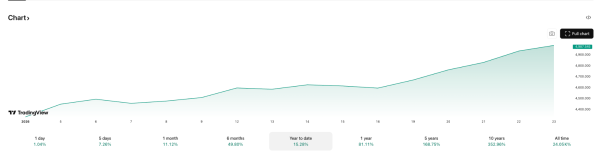
Gold prices have surged to record highs at the start of 2026, hovering near $5,000, with an artificial intelligence (AI) model suggesting further upside.
Over the past year, gold has been among the best-performing assets, driven by strong macroeconomic, financial, and geopolitical forces.
Despite periodic overbought signals, prices have remained resilient, with consolidation replacing sharp pullbacks, pointing to strong underlying demand. Aggressive central bank buying, particularly from emerging markets, has provided structural support, while private investment flows have risen as investors seek protection from economic uncertainty.
At the same time, expectations of lower real interest rates and potential rate cuts later in 2026 have further boosted gold’s appeal, alongside persistent inflation concerns and fiscal uncertainty.
Notably, gold ended the last session trading at $4,987, up over 1% on the day, while in 2026, the yellow metal has rallied more than 15%.
To determine how gold might trade by the end of the quarter, Finbold turned to OpenAI’s ChatGPT, which projects that gold will maintain its upward bias through the first quarter of 2026, though with moderated momentum compared to the explosive gains seen earlier.
Gold price prediction
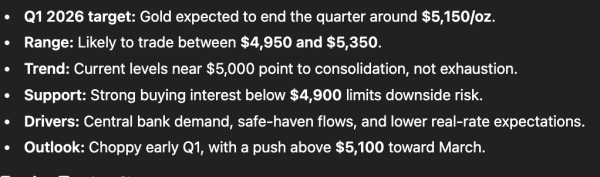
According to ChatGPT, gold is expected to end Q1 2026 at approximately $5,150 per ounce, with a projected trading range between $4,950 and $5,350.
This prediction is based on several factors. First, current price action near $5,000 suggests consolidation rather than exhaustion, indicating the market is absorbing gains rather than reversing.
Second, strong buying interest below the $4,900 level points to firm support, limiting the scope for deep pullbacks.
Third, while macroeconomic conditions remain supportive, the relatively short time frame of Q1 reduces the likelihood of an unchecked parabolic move.
Finally, psychological price dynamics suggest that once a major round number such as $5,000 is approached, prices often overshoot before stabilizing. ChatGPT expects gold to trade in a choppy but constructive range through February, followed by a push above $5,100 in March before mild investor profit-taking toward the end of the quarter.
Risks to this outlook include a sharp shift toward risk-on sentiment or unexpectedly restrictive monetary policy, which could pressure prices lower, as well as renewed geopolitical shocks that could accelerate gains beyond current expectations.
 Bitcoin
  Ethereum
  Tether
  XRP
XRP  BNB
BNB  USDC
USDC  Solana
  TRON
TRON  Lido Staked Ether
  Figure Heloc
  Dogecoin
  WhiteBIT Coin
  USDS
USDS  Hyperliquid
  LEO Token
  Wrapped stETH
  Cardano
  Bitcoin Cash
  Wrapped Bitcoin
  Monero
  Binance Bridged USDT (BNB Smart Chain)
  Chainlink
  Wrapped Beacon ETH
  Canton
  Zcash
Zcash  Stellar
  Wrapped eETH
  MemeCore
  USD1
USD1  sUSDS
sUSDS  Dai
Dai  Litecoin
  Avalanche
  Coinbase Wrapped BTC
  Hedera
  Ethena USDe
  Sui
Sui  WETH
WETH  Shiba Inu
  Rain
Rain  PayPal USD
  USDT0
USDT0  Toncoin
  Cronos
  Circle USYC
  Tether Gold
  Global Dollar
  Bittensor
  World Liberty Financial
  Ethena Staked USDe
  BlackRock USD Institutional Digital Liquidity Fund
  PAX Gold
  Mantle
  Polkadot
  Sky
Sky  Uniswap
  Pi Network
  Falcon USD
  OKB
OKB  NEAR Protocol
  Little Pepe
  HTX DAO
  Aster
Aster  syrupUSDC
  Pepe
Pepe  Ripple USD
  Aave
Aave  USDD
USDD  Bitget Token
  Janus Henderson Anemoy Treasury Fund
  Internet Computer
  BFUSD
BFUSD  Ethereum Classic
  Ondo US Dollar Yield
  Ondo
Ondo  Morpho
  KuCoin
  Gate
Gate  Jupiter Perpetuals Liquidity Provider Token
  Pump.fun
  Superstate Short Duration U.S. Government Securities Fund (USTB)
  Spiko EU T-Bills Money Market Fund
  United Stables
  Algorand
  Jito Staked SOL
  Quant
Quant  Cosmos Hub
  Kelp DAO Restaked ETH
  POL (ex-MATIC)
  Blockchain Capital
  Binance-Peg WETH
  Ethena
  Rocket Pool ETH
  Render
  Kaspa
Kaspa  Binance Bridged USDC (BNB Smart Chain)
  NEXO
NEXO  Worldcoin
  Wrapped BNB
  Stable
  Function FBTC
  Aptos
Aptos  Arbitrum
  Filecoin
  Provenance Blockchain
  JUST
JUST  syrupUSDT
  DeXe
DeXe  Jupiter
  Flare
Flare  Binance Staked SOL
  Pudgy Penguins
  Beldex
  VeChain
  XDC Network
  OUSG
OUSG  USDtb
USDtb  NEW X CEO IS BACK
  Polygon Bridged USDC (Polygon PoS)
  GHO
GHO  Solv Protocol BTC
  Official Trump
  Lombard Staked BTC
  Midnight
  Usual USD
  Bonk
Bonk  clBTC
clBTC  YLDS
YLDS  Siren
Siren  Chiliz
  TrueUSD
  PancakeSwap
  A7A5
A7A5  StakeWise Staked ETH
  edgeX
edgeX  Manadia
  Kinetiq Staked HYPE
  Artificial Superintelligence Alliance
  tBTC
tBTC  Virtuals Protocol
  WrappedM by M0
  Dash
Dash  EURC
EURC  Tezos
Tezos  Aerodrome Finance
  ADI
ADI  Stacks
  c8ntinuum
  Venice Token
  Mantle Staked Ether
  First Digital USD
  Janus Henderson Anemoy AAA CLO Fund
  Polygon PoS Bridged DAI (Polygon POS)
  Sei
Sei  Terra Luna Classic
  Resolv wstUSR
  COCA
COCA  USX
USX  币安人生 (BinanceLife)
  Injective
  Doge Strategy
  Liquid Staked ETH
  LayerZero
  Arbitrum Bridged WBTC (Arbitrum One)
  Zebec Network
  Kinesis Gold
  Ether.fi
  Monad
Monad  Wrapped Flare
  Sun Token
  SPX6900
  L2 Standard Bridged WETH (Base)
  Curve DAO
  Steakhouse USDC Morpho Vault
  Lido DAO
  Decred
  Gnosis
  PRIME
PRIME  Binance-Peg XRP
  Celestia
  Ether.Fi Liquid ETH
  BitTorrent
  Renzo Restaked ETH
  Bitcoin SV
  FLOKI
FLOKI  Noon
Noon  sBTC
sBTC  AINFT
AINFT  Conflux
  Olympus
  Jupiter Staked SOL
  DoubleZero
  Savings USDD
  JasmyCoin
  Maple Finance
  USDai
USDai  Marinade Staked SOL
  Ape and Pepe
  Arbitrum Bridged WETH (Arbitrum One)
  crvUSD