Polkadot’s treasury became more active and more conservative in the fourth quarter (Q4) of 2025, according to a new treasury report.
The Polkadot treasury spent $7.4 million in Q4, the lowest level since OpenGov was introduced. Polkadot’s governance transitioned to the OpenGov model in June 2023.
After accounting for inflation and token burn, the treasury posted a net profit of 1.6 million $DOT, its first positive result under the current system. At the end of the quarter, the treasury held about 32 million $DOT, worth roughly $58 million.
The report outlined that most spending went to core areas: Development received $2.5 million, followed by outreach at $1.7 million and operations at $1.3 million. Meanwhile, a record 68% of spending was handled through departments and bounties. Another 30% of spending was done in stablecoins.
The treasury also became more active across the Polkadot ecosystem, with around $3.8 million deployed into DeFi-related market operations. The report noted that funds were managed across multiple parachains, including Hydration and Bifrost. The treasury now holds a mix of $DOT, USDT, USDC and HOLLAR.
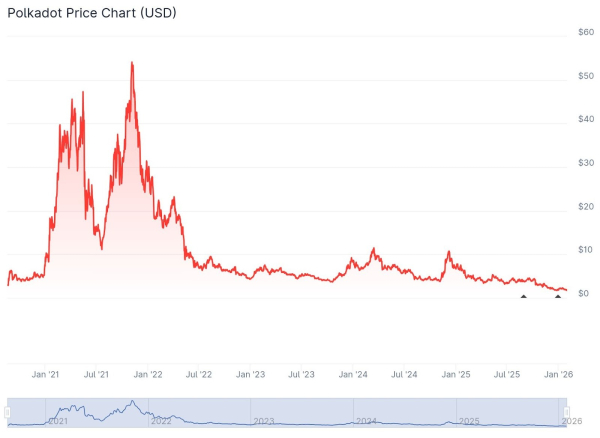
Despite all of this, $DOT’s price remains near all-time lows. Today, the token is trading at $1.69, down 72% over the past year, per CoinGecko.
$DOT Chart
The findings align with broader trends across interoperability solution blockchains. In a separate report released earlier today, Sygnum said interoperability activity continues to expand, while tokens tied to these networks struggle to record gains. It found that tokens linked to Polkadot, Cosmos, and other interoperability projects are trading near multi-cycle lows.
For example, Cosmos’ native token ATOM is trading around $2.10, down about 66% over the past year, according to CoinGecko data. LayerZero’s native token ZRO is also lower, trading near $2.01, down roughly 45% over the same period, despite new partnerships and growing cross-chain use cases.
Sygnum cites Chainlink as the exception among interoperability projects. This is mainly due to the Cross-Chain Interoperability Protocol (CCIP) expanding across blockchains and service providers. For example, Coinbase recently selected CCIP as the bridging solution for its wrapped assets, which are valued at about $8 billion.
 Bitcoin
  Ethereum
  Tether
  XRP
XRP  BNB
BNB  USDC
USDC  Solana
  TRON
TRON  Lido Staked Ether
  Figure Heloc
  Dogecoin
  WhiteBIT Coin
  USDS
USDS  Hyperliquid
  LEO Token
  Wrapped stETH
  Cardano
  Bitcoin Cash
  Wrapped Bitcoin
  Monero
  Binance Bridged USDT (BNB Smart Chain)
  Chainlink
  Wrapped Beacon ETH
  Zcash
Zcash  Canton
  Stellar
  Wrapped eETH
  USD1
USD1  Dai
Dai  sUSDS
sUSDS  Litecoin
  Avalanche
  Ethena USDe
  Coinbase Wrapped BTC
  MemeCore
  Hedera
  Rain
Rain  WETH
WETH  Shiba Inu
  Sui
Sui  PayPal USD
  USDT0
USDT0  Toncoin
  Cronos
  Circle USYC
  Tether Gold
  Bittensor
  Global Dollar
  BlackRock USD Institutional Digital Liquidity Fund
  Ethena Staked USDe
  PAX Gold
  Mantle
  Uniswap
  Polkadot
  Sky
Sky  Pi Network
  Falcon USD
  World Liberty Financial
  OKB
OKB  Aster
Aster  Little Pepe
  Pepe
Pepe  NEAR Protocol
  syrupUSDC
  HTX DAO
  Ripple USD
  USDD
USDD  Bitget Token
  Aave
Aave  Ondo US Dollar Yield
  Ethereum Classic
  BFUSD
BFUSD  Janus Henderson Anemoy Treasury Fund
  Ondo
Ondo  Internet Computer
  Morpho
  KuCoin
  United Stables
  Jupiter Perpetuals Liquidity Provider Token
  POL (ex-MATIC)
  Quant
Quant  Spiko EU T-Bills Money Market Fund
  Superstate Short Duration U.S. Government Securities Fund (USTB)
  Algorand
  Jito Staked SOL
  Blockchain Capital
  Cosmos Hub
  Kelp DAO Restaked ETH
  Ethena
  NEXO
NEXO  Binance-Peg WETH
  Kaspa
Kaspa  Rocket Pool ETH
  Render
  Gate
Gate  Binance Bridged USDC (BNB Smart Chain)
  Aptos
Aptos  Worldcoin
  Wrapped BNB
  Arbitrum
  Function FBTC
  Stable
  JUST
JUST  Filecoin
  Pump.fun
  Flare
Flare  syrupUSDT
  Pudgy Penguins
  VeChain
  Beldex
  Binance Staked SOL
  OUSG
OUSG  Jupiter
  XDC Network
  GHO
GHO  USDtb
USDtb  Usual USD
  NEW X CEO IS BACK
  Polygon Bridged USDC (Polygon PoS)
  Provenance Blockchain
  Solv Protocol BTC
  Bonk
Bonk  Lombard Staked BTC
  Official Trump
  YLDS
YLDS  Midnight
  clBTC
clBTC  Siren
Siren  DeXe
DeXe  TrueUSD
  A7A5
A7A5  Dash
Dash  PancakeSwap
  StakeWise Staked ETH
  Virtuals Protocol
  MegaUSD
  Kinetiq Staked HYPE
  Artificial Superintelligence Alliance
  tBTC
tBTC  EURC
EURC  WrappedM by M0
  Chiliz
  ADI
ADI  Aerodrome Finance
  edgeX
edgeX  Venice Token
  Stacks
  c8ntinuum
  Janus Henderson Anemoy AAA CLO Fund
  Mantle Staked Ether
  First Digital USD
  Tezos
Tezos  Polygon PoS Bridged DAI (Polygon POS)
  Terra Luna Classic
  Sei
Sei  Resolv wstUSR
  COCA
COCA  USX
USX  Manadia
  Injective
  Doge Strategy
  Liquid Staked ETH
  币安人生 (BinanceLife)
  Arbitrum Bridged WBTC (Arbitrum One)
  LayerZero
  Monad
Monad  Kinesis Gold
  Sun Token
  Wrapped Flare
  Curve DAO
  SkyAI
SkyAI  L2 Standard Bridged WETH (Base)
  SPX6900
  Steakhouse USDC Morpho Vault
  Ether.fi
  Humanity
  Decred
  Gnosis
  Celestia
  Binance-Peg XRP
  Zebec Network
  Ether.Fi Liquid ETH
  PRIME
PRIME  Renzo Restaked ETH
  Bitcoin SV
  Lido DAO
  Noon
Noon  sBTC
sBTC  BitTorrent
  FLOKI
FLOKI  Conflux
  Jupiter Staked SOL
  AINFT
AINFT  Savings USDD
  USDGO
USDGO  crvUSD
  Olympus
  Marinade Staked SOL
  BUILDon
  Arbitrum Bridged WETH (Arbitrum One)